Formative assessments in MYP: A guide

Download Resource!
Making the most of formative assessments in the MYP
The International Baccalaureate (IB) Middle Years Programme (MYP) is built on inquiry-based learning. Inside that structure, formative assessment is not just a useful tool. It is a pivotal component of the entire teaching and learning process, and it directly shapes the holistic development of an MYP learner.
TL;DR
Formative assessments in the MYP are low-stakes, criterion-aligned activities that IB MYP teachers use during a unit to give students continuous feedback on progress, surface misconceptions early, and build readiness for the higher-stakes summative tasks aligned to MYP criteria A, B, C, and D.
AssessPrep is the AI-powered on-screen assessment platform IB MYP teachers use to design and deliver low-stakes formative checks with criterion-aligned rubrics, multimodal question types (hotspots, drag-and-drop, audio, video), and instant analytics that surface misconceptions before the next lesson.
Stage | What effective MYP formative assessment looks like |
|---|---|
Anchor to the unit | Start with the Statement of Inquiry (SoI), the target subject-group criterion (A/B/C/D), and the ATL skill being developed. The task is built around the learning objective, not a topic check. |
Choose a low-stakes method | Move beyond static worksheets. Use interactive hotspots, embedded video questions, audio responses, drag-and-drop, and rich-media MCQs to surface student thinking without exam-day stakes. |
Craft a clear task | Write task instructions in student-friendly language, directly tied to the learning objective. Specify what success looks like, not just what to do. |
Define and feed-forward | Use "look-fors" (specific success criteria) instead of full rubrics. Replace praise-only feedback with feed-forward: positive, actionable suggestions for the next attempt. |
Make the mark scheme transparent | Build and attach a rubric or "look-fors" checklist to the task. AI-assisted rubric generation cuts setup time, and students self-assess against visible criteria. |
Why formative assessments are essential in MYP
At its core, formative assessment is assessment for learning. Effective formative assessments are an ongoing, diagnostic process that gives both students and teachers immediate feedback on progress toward learning goals. Unlike summative assessment, which is of learning (an end-of-unit exam, for example), formative assessments are low-stakes or no-stakes activities that inform the next steps in MYP teaching and learning.
The IB's pedagogical philosophy, as set out in publications like MYP: From Principles into Practice, supports this approach. The IB emphasises that assessment should be a continuous dialogue, where "teachers and students become partners in learning." Formative assessments are the key mechanism for this MYP partnership.
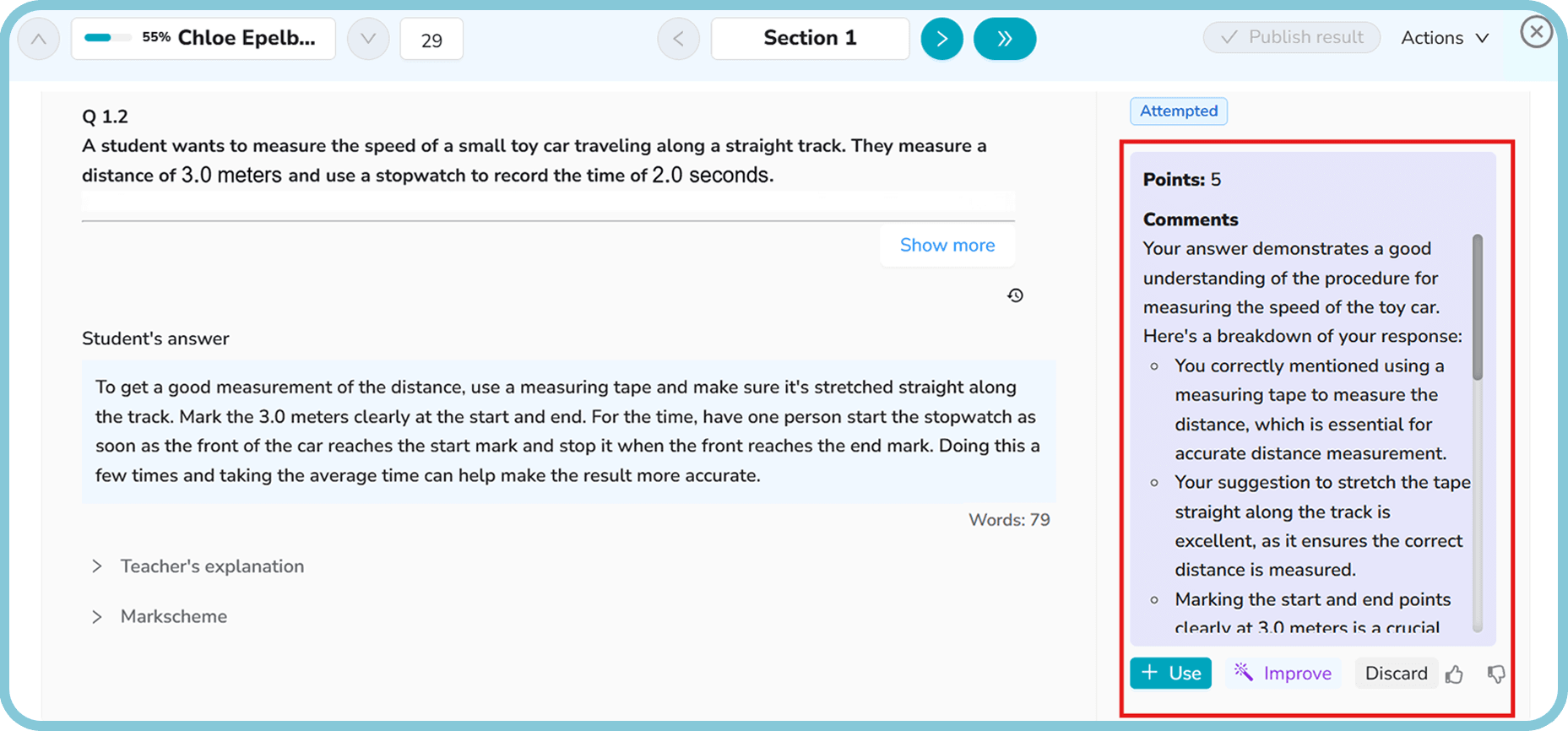
With formative assessments in the MYP, educators provide ongoing feedback that helps students identify their strengths and areas for growth, regularly check their understanding, tailor their approach, and ensure students grasp foundational concepts before moving on. This continuous feedback loop has a direct, measurable impact on MYP summative assessment results. Students are better prepared and more confident when they tackle higher-stakes tasks.
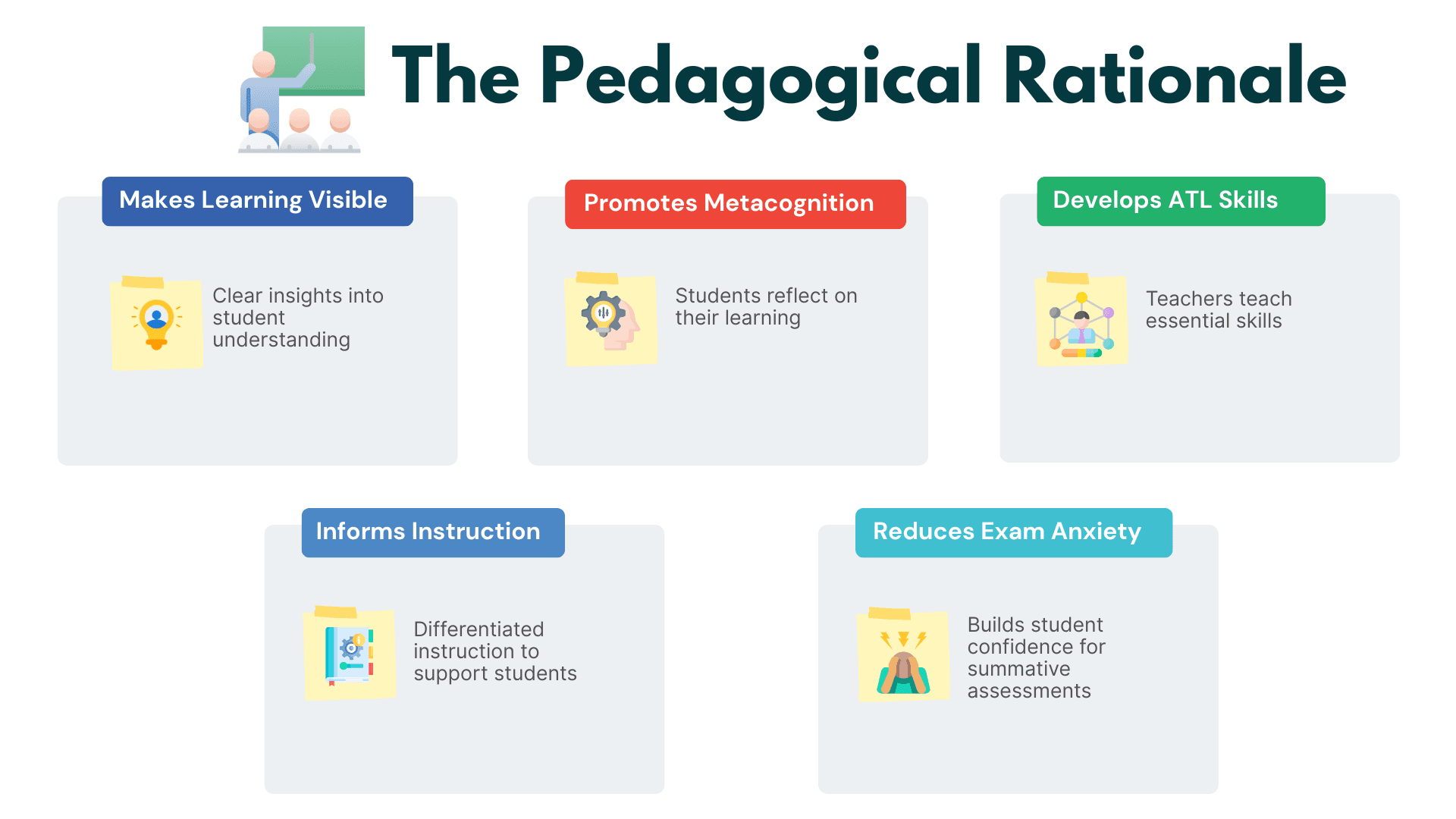
How to design effective MYP formative assessments: A step-by-step guide
Creating a formative assessment task is more than a quick quiz. It requires deliberate design that aligns with the MYP objectives and skills you want to develop.
Step 1: Deconstruct the Statement of Inquiry and learning objectives
Start with your MYP unit's Statement of Inquiry (SoI) and ask: what are the core understandings you want MYP students to develop? From there, identify the specific MYP subject-group objectives (Criteria A, B, C, D) and the ATL skills you will target in that unit.
Example:
Subject: MYP 3 Science
Statement of Inquiry: Understanding the delicate balance within ecosystems requires us to model complex relationships and predict the consequences of change.
Target Criterion: Criterion A: Knowing and understanding
Target ATL Skill: Communication (organising and depicting information logically)
Step 2: Choose a "low-stakes" assessment method
Select a method that allows for quick feedback without exam-day stakes. On a platform like AssessPrep, you move beyond static worksheets and engage MYP students with dynamic question formats. The goal is information, not a grade.

Examples:
Interactive hotspots: upload an image (a cell diagram or historical map) and have students click on specific areas to identify components.
Video-based questions: embed a short video clip and insert questions at key moments to check for comprehension.
Audio responses: ask students to record a short audio clip to explain their reasoning, which is useful for practising communication skills.
Drag-and-drop: create labelling exercises, sequencing tasks, or classification activities where students manipulate elements on screen.
MCQ simulations: use multiple-choice questions with rich media and detailed per-option feedback to simulate decision-making processes.
Step 3: Craft a clear and focussed task for students
The MYP formative assessment task should link directly to the learning objective identified in Step 1. The instructions must be clear, concise, and use student-friendly language.
Example task for an MYP 3 Science unit: On the provided diagram of a forest food web, predict and illustrate what would happen to the populations of owls and mice if the snake population were completely removed. Write two sentences to justify your prediction.
Example task using a drag-and-drop format: On the provided diagram of a forest food web, drag the "UP" arrow to the populations you predict will increase and the "DOWN" arrow to the populations you predict will decrease if the snake population is removed. Then, in the text box below, write two sentences to justify your choices.
Step 4: Define success (and provide feed-forward)
How will you and the MYP student know they are on the right track? You do not need a full rubric, but clear "look-fors" are essential. The feedback you provide should be feed-forward: positive, actionable suggestions for what to do differently or better next time.
Example look-fors and feed-forward:
Look-for: the diagram accurately shows an increase in mice and a decrease in owls. Feed-forward: "Excellent prediction. Now, can you add one more level of impact? What might happen to the insect population if mice increase?"
Look-for: the justification uses key vocabulary like predator, prey, and population. Feed-forward: "You have clearly understood the relationship. Try incorporating the term interdependence into your next explanation to elevate your scientific communication."
Step 5: Create a clear mark scheme or "look-fors"
To make feedback transparent, MYP students need to understand the goalposts. A simple, task-specific mark scheme, or a checklist of "look-fors", clarifies expectations and lets students self-assess against visible criteria.
AssessPrep streamlines this process. Teachers build and attach a rubric directly to the formative task. AI assistance inside the platform generates a draft mark scheme from your prompt and target criteria, which cuts setup time and gives students visibility on the look-fors from the start.
[Download CTA: Download our strategies that you can use for making an effective MYP formative assessment]
Leveraging digital tools for enhanced formative assessment
Formative assessment is shifting from purely mark-based to learning-based. Digital platforms support that shift for MYP educators. Tools that incorporate AI, VR, and AR are not just delivery channels for content. They help MYP teachers translate formative assessment into more tangible learning outcomes.
Teachers achieve several specific goals with these tools:
Time savings: digital platforms can save educators over 30% of their time (based on various studies on assessment automation), particularly through auto-grading for recall-based tasks and streamlined feedback. The hours freed up go back into personalised student interactions.
Future-proofing students: integrating modern assessment tools exposes students to the technologies they will use in higher education and the workplace, which builds digital fluency in context.
Richer data insights: digital platforms surface actionable data on student performance so teachers spot common misconceptions and areas of excellence quickly. The result is more targeted interventions.
Conclusion: Smarter formative assessment with technology
Formative assessment in the MYP is less about judgement and more about guidance. With a mix of strategies and modern digital tools, MYP educators build a more responsive, engaging, and effective learning environment. Auto-grading and streamlined feedback cut the labour-intensive parts of the process, which frees teachers to focus on what only humans do well: supporting student growth and understanding.
Ready to enhance your MYP formative assessment practices? Explore how AssessPrep streamlines your workflow with auto-grading and comprehensive analytics, so formative assessment actually works for you and your MYP students.
Key takeaways
Formative assessments in the MYP are low-stakes, criterion-aligned tasks that surface misconceptions early and prepare students for higher-stakes summative work.
Effective design starts with the Statement of Inquiry, the target MYP criterion (A/B/C/D), and the ATL skill being developed.
Move beyond static worksheets. Use interactive hotspots, video questions, audio responses, drag-and-drop, and rich-media MCQs to surface student thinking without exam pressure.
Replace praise-only feedback with feed-forward. Specific, actionable suggestions for the next attempt drive measurable improvement on subsequent tasks.
Digital platforms like AssessPrep cut setup and grading time by automating rubric attachment, AI-assisted mark scheme generation, and auto-grading for recall-based tasks. Studies on assessment automation report 30%+ time savings for educators.
Frequently asked questions
What is formative assessment in the MYP?
Formative assessment in the IB Middle Years Programme is a low-stakes, ongoing process where teachers gather evidence of student learning during a unit to inform the next teaching steps. Unlike summative assessment, which measures learning at a fixed point, MYP formative assessment supports learning along the way and is typically aligned to the four MYP criteria (A, B, C, D) and the ATL skills being developed.
How do MYP formative assessments differ from summative assessments?
Summative assessments are assessments OF learning, exam-style tasks that produce a final grade against MYP criteria. Formative assessments are assessments FOR learning, diagnostic activities that surface misconceptions and inform what comes next. Both matter, but formative is typically low-stakes or no-stakes, runs continuously through a unit, and feeds the planning of the next lesson rather than a final grade.
What are some examples of formative assessment strategies for MYP teachers?
Effective MYP formative assessment strategies include interactive hotspots on diagrams or maps, embedded video questions, short audio responses, drag-and-drop labelling and sequencing tasks, and multiple-choice questions with rich media and detailed per-option feedback. The common thread is dynamic interaction tied to a specific learning objective, not static worksheets.
How can digital tools support formative assessment in the MYP?
Digital tools support formative assessment in the MYP by automating rubric attachment to tasks, generating draft mark schemes with AI from teacher prompts and target criteria, auto-grading recall-based questions, and surfacing real-time analytics that show class-level misconceptions and per-student gaps. Studies on assessment automation report educators saving 30%+ of their time.
How does feed-forward differ from feedback in MYP formative assessment?
Feedback typically describes what a student has done, often retrospectively. Feed-forward, the more useful version for formative assessment, gives the student specific, actionable suggestions for the next attempt: the next paragraph, the next experiment, the next reflection. In an MYP classroom, feed-forward usually references the criterion being developed and the ATL skill being practised.
Articles
Read more from our blog

AssessPrep or Exam.net (2027): Which assessment platform is right for your school?
Confused between AssessPrep and Exam.net in 2027? Read this comparison to pick the right digital assessment platform for your school’s exams and marking.
6 mins read

How AP FRQs are scored: The 2 marking systems explained
AP FRQs are marked by rubric rows or point by point, and AP Statistics changes in May 2027. See real mark schemes and how to grade them in class.