MYP assessment criteria A–D: all 8 subject groups
By Sidhi Baweja
Sidhi Baweja brings 11+ years of experience across consulting and edtech, with previous roles at KPMG and Accenture. At AssessPrep, she writes on IB assessment, digital examination workflows, and the operational side of running on-screen assessments for international schools.

TL;DR
Every MYP subject group is marked against four criteria. They are called A, B, C and D. Each one is scored from 0 to 8. The names of the criteria change from subject to subject. The structure does not.
Key takeaway | What it means for your school |
Each of the eight MYP subject groups uses four criteria (A–D), each scored 0–8 | A subject total is out of 32. That total converts to a 1 to 7 grade |
MYP is criterion-related, not norm-referenced | You are not ranking children against each other. You are comparing the work to a published standard & understanding their progress |
The criterion titles are fixed by the IB. The level descriptors are what ask for more as students move up | A criterion keeps its name from MYP 1 to MYP 5. The standard behind it rises |
Marking is the snapshot. Grading is the album | Marking happens on one task. Grading happens at reporting time, across many. They are different decisions |
The IB protects fairness through standard-setting for external work and moderation for internal work | A 7 at your school should mean what a 7 means anywhere else |
Two external pieces sit alongside school-based assessment: the Personal Project and optional eAssessment | eAssessment is the route to an IB-validated MYP Certificate or Course Results |
MYP assessment sounds complicated from the outside. It is not. Four criteria per subject. Each one marked from 0 to 8. Add them up, and you have a total out of 32.
The part that can confuse people is the naming. Criterion B in Sciences is not Criterion B in Arts. Teachers moving between subjects, coordinators checking a rubric, and parents reading a report card all hit the same wall.
What criterion-related assessment means
MYP assessment is criterion-related. It is not norm-referenced. That one difference explains most of how the programme works.
Norm-referenced means a student's mark depends on the class. If everyone else does badly, an average piece of work looks strong. The standard moves with the group.
Criterion-related means the standard stays still. You read the descriptor. You look at the work. You decide which descriptor the work matches. If every student in your class meets the top descriptor, every student gets the top level. Nobody is competing with anybody.
This is why students should see the criteria before they start a task. If a student can say what a level 6 looks like in their own words, their work changes. The strongest MYP classrooms share the rubric openly and use descriptor language when they give feedback.
Four ideas sit under all of it, in every subject:
Understanding and skills matter more than remembered facts
Deep understanding should transfer to new situations
Learning is applied to real contexts
You assess what you actually taught and practised
Marking and grading are not the same thing
These two words get used as if they mean one thing. They do not, and mixing them up causes real problems at reporting time.
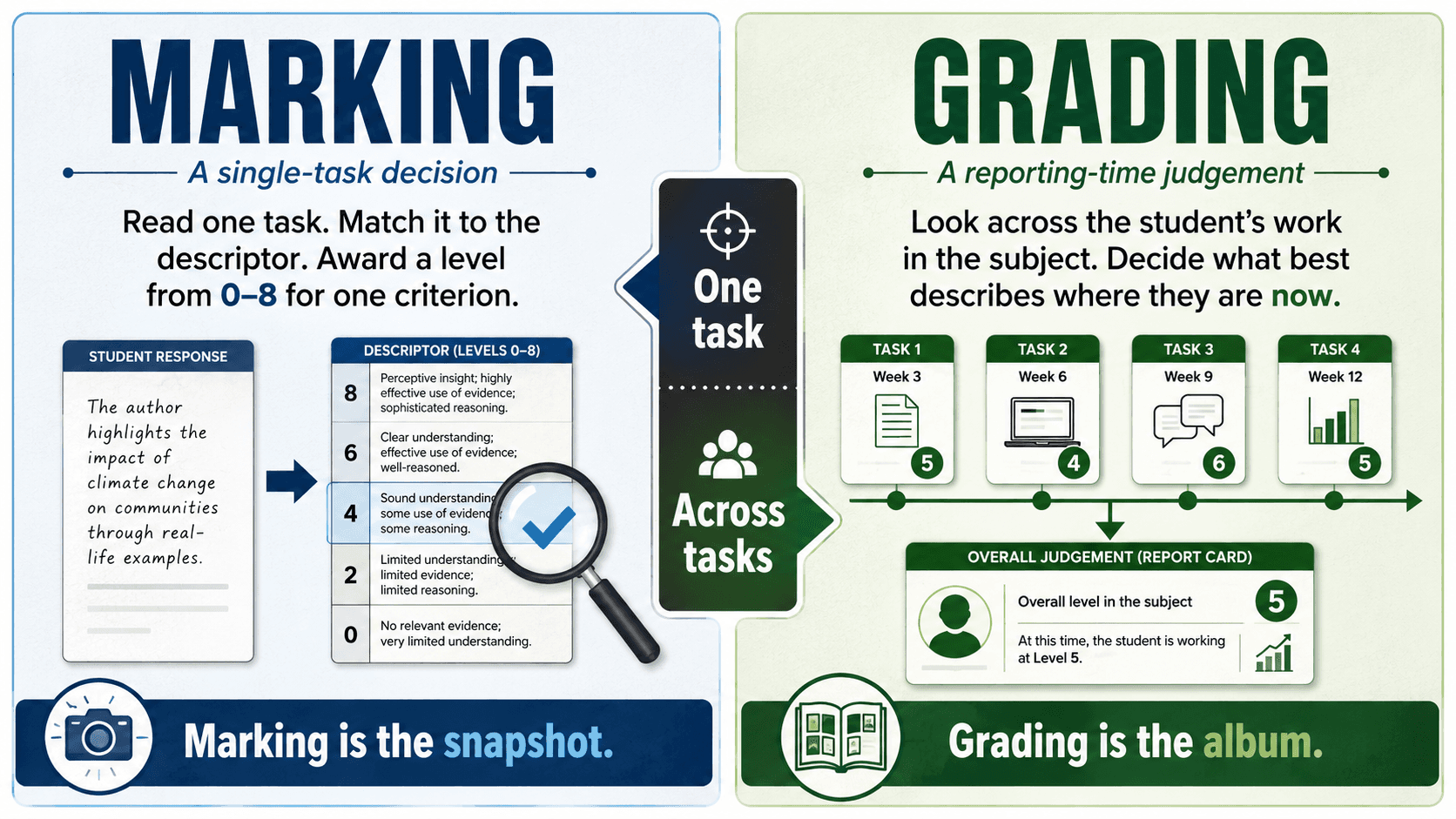
Marking happens on a single task. You read the work, you match it to a descriptor, and you award a level from 0 to 8 for one criterion. Marking is the snapshot.
Grading happens at reporting time. You look across everything a student has done for that subject, and you decide what best describes where they are now. Grading is the album.
The IB is clear that teachers assess the subject-group objectives using the assessment criteria for that subject group, in every year of the programme. How those criterion levels turn into a final grade is a separate question, and our MYP grading guide covers it in full.
MYP assessment criteria A–D for all eight subject groups
Every MYP subject group is assessed against four criteria, labelled A to D. Each criterion is scored 0 to 8, so a subject total is out of 32.
The criterion titles are fixed by the IB. They do not change as a student moves up the programme. What changes is the level descriptors, which ask for more thinking each year.
Subject group | Criterion A | Criterion B | Criterion C | Criterion D |
Language and Literature | Analysing | Organizing | Producing text | Using language |
Language Acquisition | Listening | Reading | Speaking | Writing |
Individuals and Societies | Knowing and understanding | Investigating | Communicating | Thinking critically |
Sciences | Knowing and understanding | Inquiring and designing | Processing and evaluating | Reflecting on the impacts of science |
Mathematics | Knowing and understanding | Investigating patterns | Communicating | Applying mathematics in real-life contexts |
Arts | Investigating | Developing | Creating or performing | Evaluating |
Physical and Health Education | Knowing and understanding | Planning for performance | Applying and performing | Reflecting and improving performance |
Design | Inquiring and analysing | Developing ideas | Creating the solution | Evaluating |
There are exceptions to the four-criteria rule. Interdisciplinary units use three criteria: A Evaluating, B Synthesizing, C Reflecting, for a total out of 24. The Personal Project also uses three: A Planning, B Applying skills, C Reflecting, again out of 24. (Note: For schools where the MYP ends in Year 3 or 4, the Community Project serves as the mandatory culminating task instead of the Personal Project. While it shifts the focus toward community service and typically culminates in an oral presentation, it likewise stands apart from the standard subject group structure.) If your reporting template totals either of them out of 32, the converted grade will be wrong.
Do the criteria change from MYP 1 to MYP 5?
The titles do not. Criterion B in Sciences is Inquiring and designing in MYP year 1, and it is Inquiring and designing in MYP year 5.
What changes is the level descriptors. A year 1 student might be asked to identify and comment. A year 5 student is asked to analyse and justify. Same criterion, harder thinking.
This is why a student can score a 6 in year 1 and a 6 in year 5 and have made a lot of progress in between. The number is the same. The standard behind it is not.
Approaches to Learning skills sit across all of this. Thinking, communication, self-management, research and social skills are planned for and reflected on inside subject units rather than graded on their own. The IB sets them out in the Middle Years Programme curriculum.
How MYP marking stays consistent across schools
Two mechanisms keep the standard steady, and they work on different things.
Standard-setting covers externally marked components. Principal Examiners run standardisation meetings and monitor examiners, so a student's result does not depend on who happened to mark the paper.
Moderation covers internally marked components. The IB checks a sample of a school's marking against a global standard. A school's marks may be lowered, raised, or left where they are.
Both matter more than any conversion table. If your department marks to the descriptor consistently, moderation confirms you. If it does not, no table will fix the grades.
The practical version of this inside a school is standardisation. Sit down with your subject team before final grades go out. Bring real student work. Compare the levels you would each award. Talk through the ones you disagree on. When you award a level 5, your colleagues should be awarding a 5 for comparable work.
Where the 1 to 7 grade comes from
Add the four criterion levels for a total out of 32. That total becomes the final 1 to 7 grade.
Schools using the MYP 1 to 7 scale use the IB's grade boundary guidelines table to make that conversion. It is the IB's table, not a school invention. A total of 28 to 32 converts to a grade 7, and the rest of the scale follows the same published bands. Schools that report on an equivalent local or national scale may use that instead, but a school reporting in MYP 1 to 7 should be applying the IB's boundaries.
Official eAssessment works differently again. There, the IB's grade award team sets subject-specific boundaries for each session, comparing student performance against the grade descriptors and adjusting for how demanding that session's assessment turned out to be. Those boundaries can move from session to session, so never assume last session's numbers.
The full table, the percentage question, and how boundaries shift between sessions are all in our MYP grading guide.
External validation: the Personal Project and optional eAssessment
The Personal Project: three criteria, marked out of 24
The Personal Project is assessed against three criteria, not the four used in subject groups: A Planning, B Applying skills, C Reflecting. Each is scored 0 to 8, so the project is marked out of 24.
Every MYP year 5 student completes it. Unlike internal subject assessment, it is externally moderated by the IB. Schools submit a sample and the IB checks the school's marking against a global standard.
It is a sustained, independent piece of work leading to a personal and creative outcome. Done well, it becomes the thing students remember from their secondary years. Final achievement is recorded in the MYP Course Results document.
To be eligible for the MYP Certificate, students must have participated in the final year of the programme.
eAssessment: the optional external route
Schools may register for eAssessment, which leads to the IB-recognised MYP Certificate. It runs as on-screen examinations and as ePortfolios of coursework.
That is the whole of it on this page. Formats, durations, session dates, results dates and preparation are covered in our IB MYP eAssessment guide.
Five things MYP coordinators can do this term
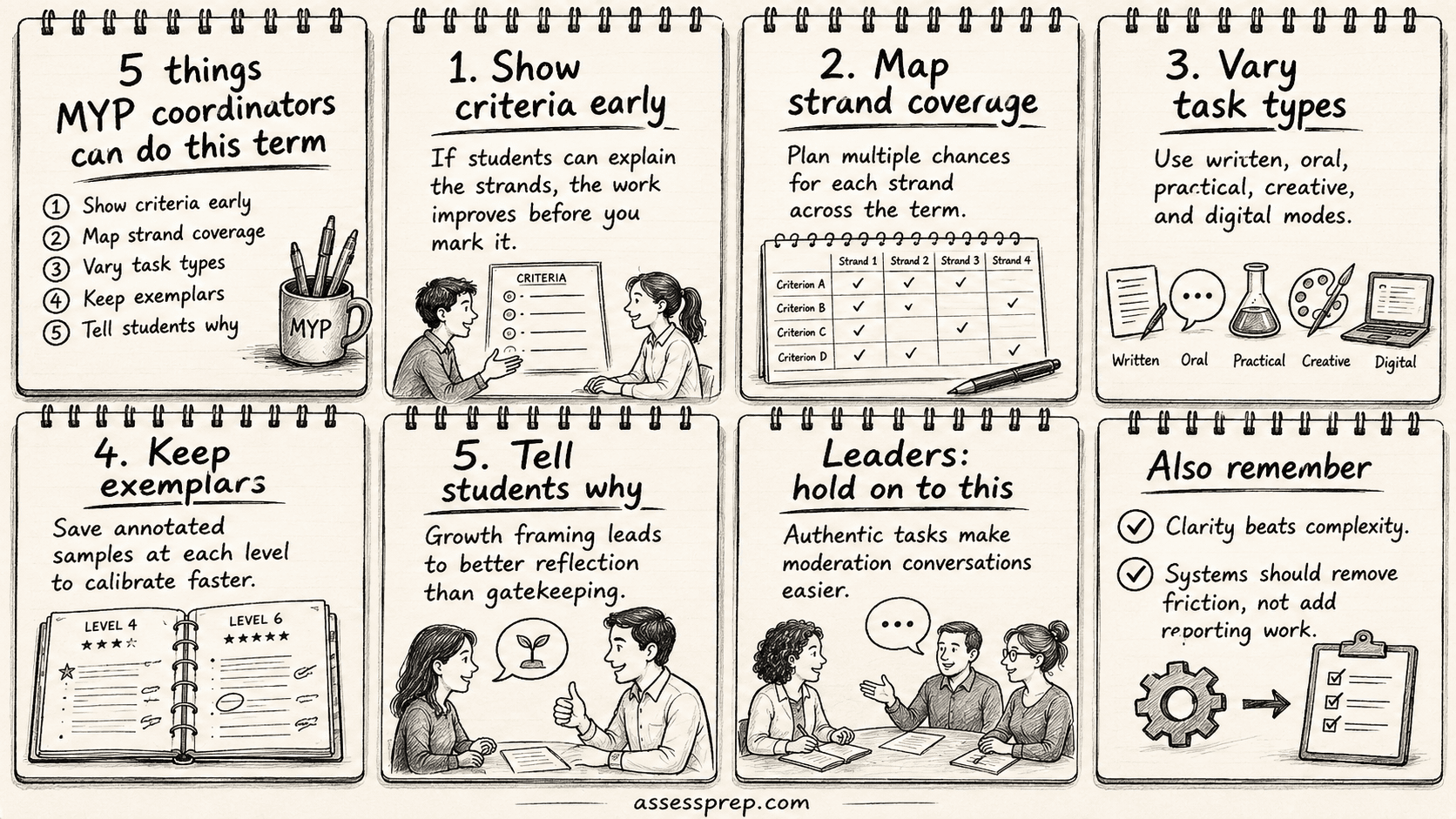
Put the criteria in front of students early. If students can explain the strands in their own words, the work changes before you mark it.
Map coverage by criterion and strand. Plan several chances at each strand across a term. Do not hang a criterion on one big task.
Vary the task type. Written, oral, practical, creative, digital. Different modes give you a more reliable picture than five versions of the same thing.
Keep annotated exemplars. Save marked samples at each level. New teachers calibrate faster, and everyone else has something to check against at 10pm.
Tell students why. Assessment framed as growth gets better reflection than assessment framed as a gate.
Three things are worth holding on to as a leader. Authentic tasks make moderation conversations easier. Clarity beats complexity, so share the criteria and echo the descriptor language. And systems should remove friction, not add reporting work.
Run your MYP assessment on AssessPrep
AssessPrep tags every task to the four MYP criteria, supports marking against the descriptors, and keeps a per-student evidence trail that makes a professional judgement easy to defend.
Over 800 IB and Cambridge schools use it across 85+ countries. That includes a 13,500+ question MYP bank, AI-assisted marking that speeds up the teacher's own judgement rather than replacing it, and analytics that track Criterion A to D progression over time. For schools preparing for on-screen examinations, the practice environment matches the exam environment.
Start a 30-day free trial and run one real MYP task through it this term.
Conclusion
Most MYP criteria confusion is a naming problem, not a conceptual one.
The structure is the same everywhere. Four criteria. Each marked 0 to 8. A total out of 32, except for the Personal Project and interdisciplinary units, which use three criteria and 24.
What is worth doing this term is checking that the criterion wording on your school's rubrics matches the wording in the current subject guide. Rubrics get copied, adapted and passed between teachers, and the wording drifts. It costs an afternoon to check, and it is the difference between a moderation conversation that goes well and one that does not.
Key takeaways
Every MYP subject group uses four criteria, A to D, each marked 0 to 8, for a subject total out of 32.
The criterion titles differ by subject group. Criterion B is Investigating in Individuals and Societies, Inquiring and designing in Sciences, and Planning for performance in PHE.
The Personal Project and interdisciplinary units use three criteria, marked out of 24. Total them out of 32 and the converted grade will be wrong.
MYP is criterion-related, not norm-referenced. Work is compared to a published descriptor, not to other students.
Marking is the snapshot, grading is the album. Marking is one task. Grading is a judgement across many, at reporting time.
The standard is held steady by standard-setting for external components and moderation for internal ones.
Criterion titles stay the same from MYP 1 to MYP 5. What rises is the level descriptors. Check that your school's rubric wording still matches the current subject guide.
Frequently asked questions
What are the MYP assessment criteria?
Every MYP subject group is assessed against four criteria labelled A to D, each scored from 0 to 8, giving a subject total out of 32. The titles differ by subject group. Sciences uses Knowing and understanding, Inquiring and designing, Processing and evaluating, and Reflecting on the impacts of science, while Physical and Health Education uses Knowing and understanding, Planning for performance, Applying and performing, and Reflecting and improving performance. Interdisciplinary units and the Personal Project are the exceptions: both use three criteria and are marked out of 24.
Do all MYP subject groups use the same four criteria?
They all use the same structure, but not the same names. Every subject group has four criteria labelled A to D, and every criterion is scored 0 to 8 for a total out of 32. The titles are set per subject group, so Criterion B is Investigating in Individuals and Societies, Inquiring and designing in Sciences, and Planning for performance in Physical and Health Education. This is the most common source of confusion for teachers who move between subjects, or for coordinators checking a rubric built by someone else.
Is MYP assessment criterion-related or norm-referenced?
Criterion-related. A teacher judges each piece of work against the published level descriptors for the relevant criterion and awards a level from 0 to 8, so a student is measured against a published standard rather than ranked against classmates. Two students in the same class can both reach level 7 on Criterion B, and a cohort that all meet the standard can all be graded highly. How those criterion levels then convert into a final 1 to 7 grade is a separate question, covered in our MYP grading guide.
Do MYP criteria change between year 1 and year 5?
The criterion titles do not change. Criterion B in Sciences is Inquiring and designing in MYP year 1 and in year 5. What changes is the level descriptors, which escalate in cognitive demand. A year 1 student might be asked to identify and comment, where a year 5 student is expected to analyse and justify. That is why the same criterion level in different years does not describe the same standard of work, and why rubric wording should always be checked against the current subject guide.
What are the MYP Physical and Health Education criteria?
PHE uses four criteria: A Knowing and understanding, B Planning for performance, C Applying and performing, and D Reflecting and improving performance. Each is scored 0 to 8 for a total out of 32, and the titles are the same across every MYP year. If a rubric in your school reads Knowledge and application or Performance planning, that is not IB wording. It tends to appear on school-made rubrics, and it is worth checking against the current PHE guide.
How many criteria does the MYP Personal Project have?
Three, not four. The Personal Project is assessed against Criterion A Planning, Criterion B Applying skills and Criterion C Reflecting, each scored 0 to 8, giving a total out of 24. Interdisciplinary units follow the same three-criteria pattern with Evaluating, Synthesizing and Reflecting. If a reporting template totals either of them out of 32, the converted grade will be wrong.
What is the difference between marking and grading in MYP?
Marking is the judgement on a single task: you match the work to a level descriptor and award 0 to 8 for one criterion. Grading is the separate, later decision about a body of work across a reporting period, deciding which criterion levels best represent where the student is now, given that early attempts and recent ones are not equally informative. Marking is the snapshot and grading is the album. A student can be marked many times and graded once.
Which assessment platform supports MYP criterion A to D marking?
AssessPrep supports criterion-tagged tasks, marking against the A to D descriptors, and analytics that track a student's progression on each criterion across a year, which is what a moderation or reporting conversation needs. It serves 800+ schools in 85+ countries across IB MYP, IB DP, Cambridge IGCSE and A-Level, and Pearson Edexcel, and includes a 13,500+ question MYP bank. It is an assessment platform rather than a unit-planning or curriculum system, so schools typically run it alongside their planner.
Articles
Read more from our blog

6 digital assessment tools international schools actually use in 2026
Six digital assessment tools for IB, Cambridge and Edexcel teachers, sorted by create, deliver or mark, with what each one cannot do.

10 academic integrity examples for international schools
10 real academic integrity examples for IB, Cambridge & Edexcel schools: what honest work looks like in practice, plus the classroom strategy behind each one.
3 mind read