IB MYP Grading: 0–8 Scale, Grade Boundaries & Percentages
By Sidhi Baweja
Sidhi Baweja brings 11+ years of experience across consulting and edtech, with previous roles at KPMG and Accenture. At AssessPrep, she writes on IB assessment, digital examination workflows, and the operational side of running on-screen assessments for international schools.

Download Resource!
TL;DR
MYP grading measures a student against fixed descriptors, not against the class. Four criteria, each marked 0 to 8. Add them up, convert the total, and you have a 1 to 7 grade.
Key takeaway | What it means for your school |
MYP grading is criterion-related, not norm-referenced. | Every student is measured against a published descriptor. If the whole class meets the top descriptor, the whole class earns the top level. |
Each criterion is marked 0 to 8. Level 0 is part of the scale. | Level 0 is not a punishment for a missing submission. It is the level for work that does not reach any descriptor. |
Best-fit judgement decides each 0 to 8 level. The 32-point conversion is mechanical. | The judgement work happens four times, once per criterion. After that the final grade is arithmetic against a boundary table. |
For official MYP eAssessment, the IB sets and publishes grade boundaries, and they can change every session. | Never assume last session's boundaries. Check the ones published for your subject and your session. |
There is no official percentage equivalent for MYP levels. | A level 6 is not 75%. Schools that need percentages convert the final 1 to 7 grade, using a band the school agrees itself. |
Never average criterion scores across a term. | Use best-fit judgement on the most recent and most consistent evidence. |
External moderation is what holds the standard steady between schools. | ePortfolios and the Personal Project are moderated against a global standard. The IB adjusts a school's marks if its marking runs harsh or lenient. |
AssessPrep supports MYP assessment for 800+ IB schools in 85+ countries. | Criterion-tagged tasks, descriptor-anchored marking, AI-assisted grading that speeds up the teacher's own judgement, and a per-student evidence trail. |
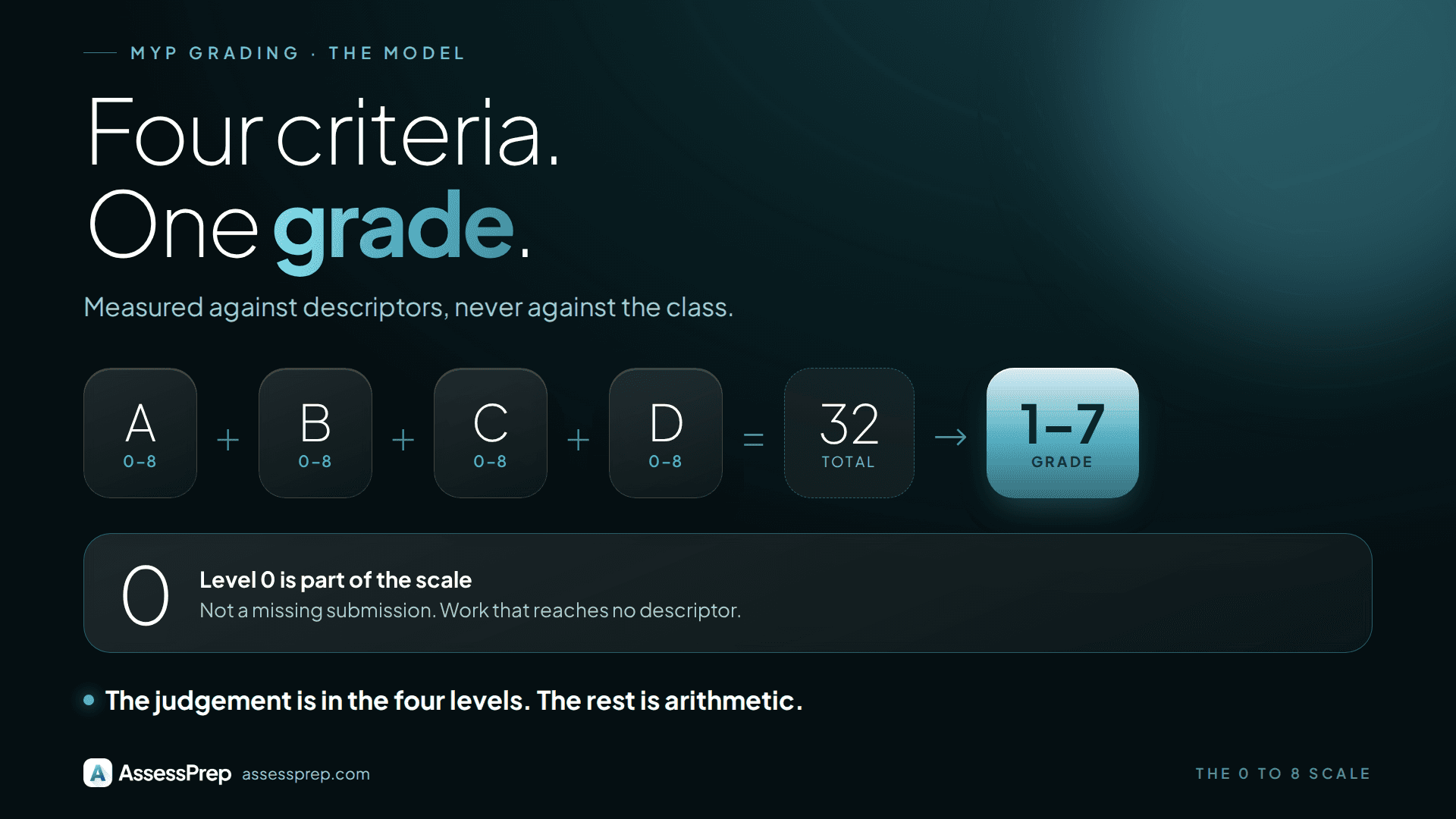
MYP grading is a criterion-related system. Students are measured against fixed descriptors across four criteria, using a best-fit professional judgement to award a mark of 0 to 8 for each. Those four levels are then added to a total out of 32 and mathematically converted to a final 1 to 7 grade. That one sentence is the whole model. Almost every MYP grading headache is a downstream effect of one of those words.
Note where the judgement sits. It sits in the four criterion levels, and nowhere else. Once you have those four numbers, the conversion is arithmetic.
It is 10pm on a Wednesday. You are looking at a student's work that has come a long way since September. The descriptors are telling you something less generous. Is it a 5 or a 6? And what do you say when the parent emails in the morning?
This guide covers the scale, the conversion, the percentage question, and the protocol that makes a borderline call defensible.
How the MYP 0–8 achievement scale works
Every MYP subject is assessed against four criteria: A, B, C and D. Each criterion is scored from 0 to 8 against the IB's published level descriptors. The criterion names change by subject. In Sciences, Criterion A is "Knowing and understanding". In Arts, Criterion B is "Developing skills". The architecture is the same everywhere.
The scale is split into bands: 1–2, 3–4, 5–6 and 7–8. Bands let you separate performance levels clearly, without the false precision of a percentage. A student on 73% and a student on 74% are the same student. A student at level 4 and a student at level 6 are materially different, and you can name why by pointing at the descriptor.
Level 0 is part of the scale
Level 0 is often overlooked. It is not an automatic zero for a missing submission. It is the level awarded when the work does not reach the standard described by any descriptor. The published wording is the same across every subject group: "The student does not reach a standard described by any of the descriptors below."
The cardinal rule: no averaging
This is the thing that trips up almost every new MYP teacher. Learning is a journey. An average punishes a student for what they did not know three months ago. It produces a hybrid of who the student was and who they are now.
MYP values the most accurate demonstration of ability. That is usually the most recent evidence, or the most consistent evidence. Not the arithmetic mean of everything in the gradebook.
Your job is not to calculate an average. It is to make a professional judgement about where the student is right now.
What "professional judgement" actually means
In some school systems, "professional judgement" sounds like "teacher's opinion". In MYP it is the opposite.
Professional judgement is a documented, descriptor-anchored decision. It lets you look at a low score in September and a high score in December and work out which one is the real story. A calculator averages numbers. An expert reads the pattern.
This is also the answer to give a sceptical parent. You are not being vague. You are being precise about something a percentage cannot capture.
Why traditional grading does not work in MYP
MYP is criterion-related, not norm-referenced. That single shift is what makes the system work.
In norm-referenced grading, a student's mark depends on where everyone else lands. If the class average is low, a mediocre piece of work can still earn an A. The standard moves with the crowd.
In MYP, the standard is fixed. If every student in your class meets the highest descriptor, every student earns the highest level. The point is to measure individual competence, not classroom rank.
The IB's assessment principles are explicit on this. MYP grades describe what a student can do against a published standard, not how they compare with their peers.
For coordinators new to the framework, our IB MYP eAssessment guide covers how the same principle plays out in the external, IB-marked assessments.
A 6-step best-fit protocol for MYP teachers
Best-fit is the IB's method for awarding a criterion level. The IB's own instruction is to start at the lowest level descriptor and move up through the descriptors until you reach the one that best describes the work.
The six steps below are our teaching framework built around that instruction, not an IB-published list. The IB mandates best-fit. It does not mandate these six steps. They are how experienced MYP teachers tend to get there without second-guessing every borderline call: gather the evidence, look at the progression, ascend through the descriptors, refine within the band, standardise with colleagues, then total the four criteria.
Done in this order, grading becomes transparent. To students, to parents, and to yourself.
Step 1. Get all the evidence on the table
Round up everything you have for that criterion. Presentations, investigations, tasks, journals, written work. Do not lean on a single final test. You need to see a pattern.
Step 2. Look at the progression, do not average it
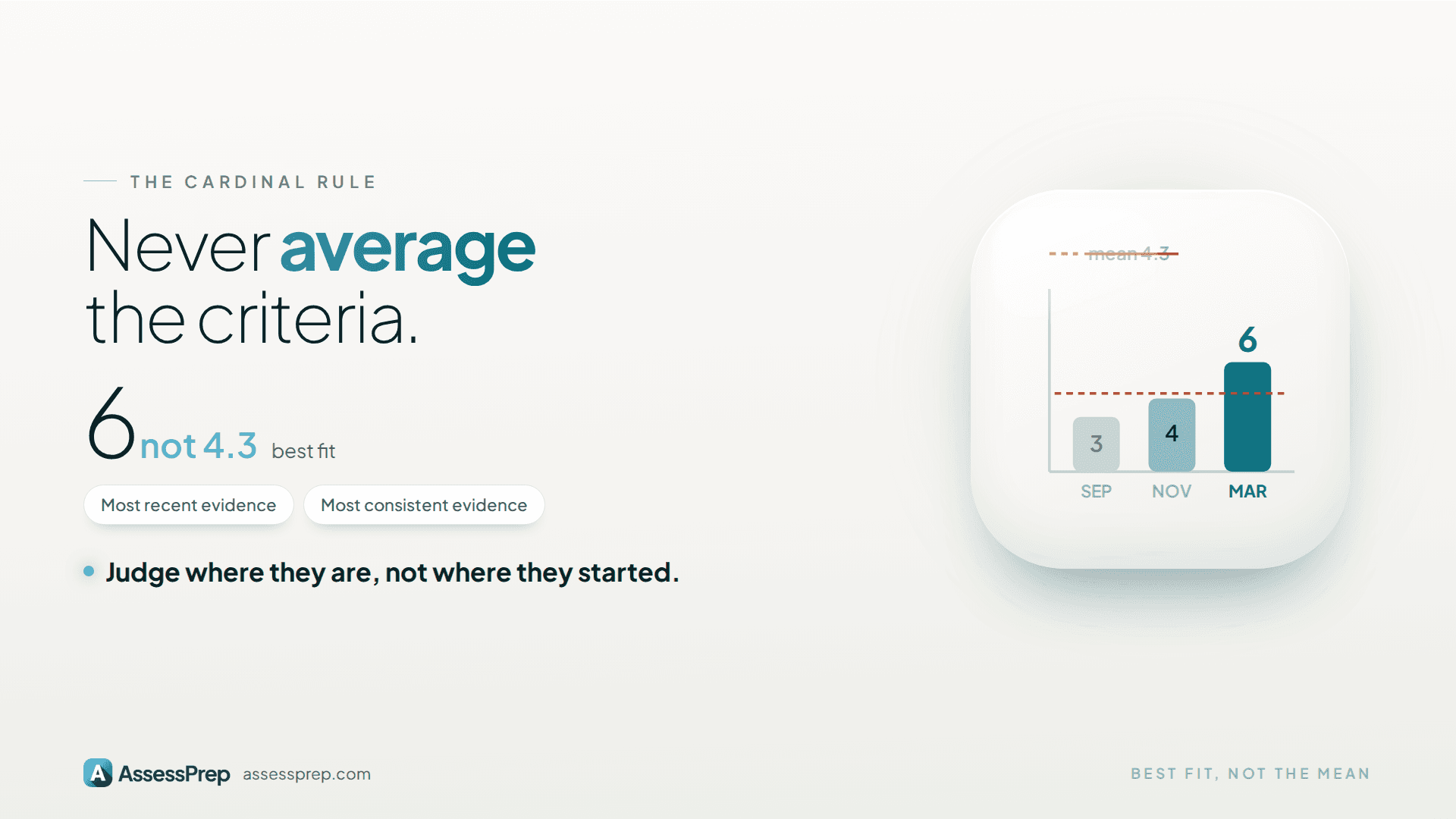
If a student scored 3 in September, 4 in November and 6 in March on Criterion A, and the March task was demanding, the best fit is probably a 6. The earlier levels are not erased. They are context. They show where the student was and where they are now.
Step 3. Ascend through the descriptors
This part is not optional. Once you do it consistently, most of the grading anxiety goes away.
Do not start in the middle. Start at the lowest band, 1–2. Read it.
Does the work match that description? If yes, move up to 3–4.
Keep moving up.
Stop at the band the work definitely does not fit.
The band below is the student's level.
Nine times out of ten you land on a borderline case. The IB's instruction here is to compensate for weak performance in one strand with strong performance in another, and take the descriptor that fits the work overall. In practice, three questions help you do that consistently:
Frequency. Is the student consistently producing work at this level, or was it a one-off?
Independence. Did they need heavy prompting to get there, or did they do it alone?
Complexity. Did they handle the harder parts of the task comfortably?
Those three are practical teaching advice, not IB wording. They are how most departments turn "best fit overall" into a decision two teachers can agree on.
A worked example. You are marking a science investigation against Criterion C, Processing and Evaluating. The calculations are correct. The graphs are clean. But the student restated the hypothesis instead of analysing the results.
Band 1–2? No. They did more than show up.
Band 3–4? The descriptor says "collects and presents data appropriately". Yes. "Interprets data and explains results"? No.
Band 5–6? No. Interpretation was not attempted.
The student gets a 4. Top of the 3–4 band, because presentation and processing were strong. The descriptor decided the level. You did not.
Step 4. Refine within the band
MYP uses bands, so you choose which end fits.
Award the lower number if the student just squeaks in, or is inconsistent.
Award the higher number if they consistently meet the band's descriptors.
The ascending process has already done most of the work.
Step 5. Standardise with colleagues
Before publishing final grades, sit down with your subject team. Bring sample work. Compare levels. Talk through where you disagree.
When you award a level 4, your colleagues should be awarding level 4s for comparable work. This is not doubting your judgement. It is making sure everyone is speaking the same language.
Step 6. Add up the criterion levels
Total A + B + C + D, out of 32. Now you are ready to convert.
This is also the point where a spreadsheet stops earning its keep. AssessPrep's MYP achievement level calculator that is there within AssessPrep’s grading abilities adds the four criterion levels and applies your school's conversion, so the arithmetic is done the same way for every student in the department.
https://framerusercontent.com/images/2OoPQENsKEtucqM24O5duTr0NxU.svg?width=389&height=516
MYP grade boundaries: converting a criterion total to a 1–7 grade
There are two different boundary situations in MYP, and most of the confusion online comes from people treating them as one.
Official MYP eAssessment | Internal school report cards | |
Who sets the boundaries | The IB | Your school |
Are they published? | Yes, by the IB, per subject | No single IB table applies |
Do they change? | Yes, every session, with the difficulty of the assessment | Only if your school changes them |
What to do | Use the boundaries published for your subject and your session | Agree one conversion, document it, apply it school-wide |
The rest of this section is about internal school report cards. Everything below is the term-time conversion your school controls. It is not the official eAssessment table and should never be used in its place.
The conversion most schools use internally
Add the four criterion levels for a total out of 32, then convert that total to a final 1 to 7 grade. The IB does not dictate how schools map criterion totals to grades on their own term report cards. Your school should confirm the conversion it uses and write it down.
MYP eAssessment works differently, and this is the part worth getting right. For official MYP eAssessment the IB absolutely does set and publish grade boundaries that convert the 32-point total into the final 1 to 7 grade. Those boundaries are subject-specific, they are set against global cohort performance, and they can change every session with the difficulty of the assessment. The total needed for a 7 in on-screen Sciences may not match Individuals and Societies, and may not match last session. Check the boundaries published for your subject and your session. Do not apply the internal table above to an eAssessment result.
Who sets the boundaries?
For official eAssessment, the IB. It publishes subject-specific boundaries each session, set against global cohort performance, and they move from session to session.
For internal report cards, your school. There is no single published IB table that applies everywhere. Most schools adopt the standard conversion above and apply it consistently across every subject and every teacher.
Can internal boundaries vary between schools?
Within a school, no. Every teacher in a subject must use the same conversion, or the integrity of the programme breaks.
Between schools, the more useful answer is that it matters less than teachers expect. The standard is held constant by moderation, not by the boundary table.
Work submitted for the MYP certificate, meaning ePortfolios and the Personal Project, is externally moderated by the IB against a global standard. If a school's marking runs harsher or more lenient than that standard, the IB applies a moderation factor and adjusts the school's marks.
That is the real safeguard. It is also why standardisation meetings inside your department are worth more than debating where a band edge should sit. Mark to the descriptor consistently and moderation confirms you. Mark inconsistently and no boundary table will save the grades.
Is there a percentage equivalent for MYP levels?
The IB does not publish one, and criterion levels are not percentages.
This is the most common question teachers and parents ask about MYP grading, and the honest answer is unsatisfying by design. A Criterion A level 6 does not mean 75%, even though 6 out of 8 looks like it should. The levels describe what the work demonstrates, not a proportion of a total. Two students can both sit at level 6 with visibly different work, and the descriptor is what justifies the level.
What to say to a parent who asks
"MYP does not work in percentages, and here is why that is better for your daughter. This grade is tied to a descriptor I can show you, not to how many marks she happened to drop."
Can AI mark MYP work?
The IB's guidance on AI tools is clear that AI-generated feedback is not acceptable for work submitted for IB assessment. Two reasons sit behind it. A student is entitled to one set of written feedback on a draft, and the IB holds that the teacher is better placed to give that feedback than a model. An AI tool producing a second round of commentary on an IB submission puts the student's work at risk, not just the teacher's workload.
Where AI does help is everywhere else, and that is most of a teacher's marking life. Formative tasks. Practice papers. Low-stakes checks. First-pass sorting of a class set against the descriptors. Drafting a rationale that the teacher then edits and owns.
The rule of thumb worth adopting as department policy is simple. On anything going to the IB, the judgement and the written feedback are the teacher's. Use AI to reach that judgement faster: surfacing the relevant descriptor, flagging where a piece sits against exemplars, catching what you missed at task forty. Not to produce the mark or the feedback itself.
If a platform cannot show you which of those two things it is doing, that is the question to ask before you buy it.
What MYP teachers wish they had known on day one
Three mistakes cost new MYP teachers the most. Each one undermines the criterion-related model from a different angle.
Treating early work as a verdict. The September diagnostic is a starting point, not a judgement. Use it to map where students are and to track progress from there.
Letting one remarkable task dominate. Accurate means representative, not exceptional. If a student nails one project but generally stumbles, do not let the outlier inflate the level beyond what the evidence supports.
Defending a grade without naming the descriptor. Never justify a level with "I felt it was a 5" or "compared to her classmates". Point at the specific language of the descriptor. That is your safety net and your proof.
How to explain a MYP grade to a parent
The hard part is rarely the grade. It is the perception that the grade is a personal whim. When parents hear "professional judgement", many hear "opinion".
The fix is a language change. Move from "I think" to "I can show you this".
What to say | What not to say |
"My judgement, based on her inability to analyse the data consistently without prompting, strand iii, places her at a 5." | "I felt he wasn't quite at a 6 yet." |
"I looked at the trajectory of her work. An average would have lowered her grade because of early struggles. My judgement weights her most recent, higher-level performance." | "I used my best-fit judgement." |
"Here is the level 6 descriptor. Here is the level 5 descriptor. Here is the work. You can see which one it matches." | "Compared to other students, this is about a 5." |
Name the criterion, quote the descriptor, show the work. That turns an opinion into something a parent can actually engage with.
Building a MYP moderation and support network
Sustainable MYP grading rests on five habits. No teacher should be doing this alone. The best-fit protocol works because the team trusts the process, not because one teacher has a perfect inner compass.
Regular moderation sessions. Recurring meetings with your subject team to review student work and talk through hard calls. These are not appraisals. They are calibration. Bring the work that stumped you.
A criterion reference library. Annotated examples of student work at each achievement level. Priceless for new teachers, and a sanity check for everyone else at 10pm.
Quick rationale notes. A short note on why you awarded each level, especially for borderline cases. Bullet points naming the descriptors that applied. Future you will be grateful.
Mentorship in both directions. New to MYP? Find a veteran. Ten years in? Mentor someone who is not. The philosophy clicks at different times for different people.
Loop in the MYP coordinator. That is what they are there for. Stuck between two levels? Ask. Good coordinators would rather help now than find out at moderation.
For a picture of how MYP teams build these habits at scale, see how GEMS World Academy did it. . It walks through how a multi-campus MYP school approached criterion-based marking across teachers and sites.
Where a digital platform helps with MYP grading
MYP schools marking criterion A to D across a department, where more than one teacher marks the same subject and consistency between them matters. Coordinators who need a per-student evidence trail for moderation or a parent meeting. Schools preparing MYP 5 students for on-screen eAssessment who want the practice environment to match the exam environment.
How AssessPrep supports MYP assessment and grading
For MYP assessments, AssessPrep is a digital assessment platform that tags every task to the four MYP criteria, and is used by over 800 IB and Cambridge schools across 85+ countries to author, deliver and grade MYP tasks. That includes AI-assisted marking aligned to the descriptors, used to speed up the teacher's own judgement rather than replace it, and analytics that show progression on Criterion A through D over time. For schools preparing for MYP on-screen examinations, the practice environment mirrors the exam environment, so students arrive on the day already familiar with it.
Start a 30-day free trial and run a real MYP task through the platform this term.
Conclusion
MYP grading asks teachers to do something harder than arithmetic. Trust that students grow. Document that growth properly. Refuse to let early struggles define the final outcome.
The 10pm moment, staring at a piece of work and wrestling with the call, is not a fault in the system. It is the most important work in teaching. Getting an honest read on where a student actually is, and having the patience to admit that learning does not follow a tidy timeline.
The rules are not hoops. Recent evidence, four-criteria triangulation, standardisation meetings. They exist to stop us labelling a child in September and moving on. When you award a 6 to a student who started the year at a 3, you are not going easy. You are being accurate. And when you can defend that level by naming the descriptor, citing the work and showing the trajectory, that is not compliance. That is good teaching.
Key takeaways
MYP criteria are marked 0 to 8, not 1 to 8. Level 0 exists and means the work does not reach any descriptor.
Best-fit judgement awards each 0 to 8 level. Once you have the four levels, adding them to 32 and converting to a 1 to 7 grade is mechanical.
For official MYP eAssessment, the IB sets and publishes the boundaries, and they can change every session with the difficulty of the assessment.
For internal school report cards, the IB does not dictate one table. The common conversion is practice, not policy. Agree yours and document it.
There is no official percentage equivalent for MYP levels. Schools that need percentages convert the final grade, using a school-agreed band.
Never average criterion scores. Apply best-fit judgement to the most recent and most consistent evidence.
External moderation of ePortfolios and the Personal Project is what holds the standard steady between schools.
On work going to the IB, the mark and the written feedback stay the teacher's. AI-assisted marking belongs to formative tasks, practice and internal checks.
Frequently asked questions
What is IB MYP grading?
IB MYP grading is the criterion-related assessment system used in the International Baccalaureate Middle Years Programme. Students are measured against four published subject criteria (A, B, C, D), each scored on a 0–8 scale. The four criterion scores total out of 32 and convert to a final 1–7 grade using subject-specific grade boundaries. Grades are awarded through best-fit professional judgement rather than averaging.
How does the best-fit approach work in MYP?
The MYP best-fit approach is a six-step process: gather evidence across multiple tasks, look at the student's progression over time, ascend through the descriptor bands from lowest to highest, refine within the band based on consistency and independence, standardise with colleagues, and total the four criterion scores. The descriptor decides the grade, not the teacher's instinct.
Why don't MYP teachers average grades?
Averaging punishes a student for what they did not know earlier in the year and produces a "zombie grade" that does not reflect current ability. MYP grading values the most accurate demonstration of ability, which is usually the most recent or the most consistent evidence. Best-fit professional judgement weighs the trajectory rather than calculating a mean.
How are MYP final grades calculated from criterion scores?
Add the four criterion scores (A + B + C + D) out of 32 and convert to a final 1–7 grade using the subject grade boundary table. The IBO sets boundaries for external eAssessments based on global cohort performance, and most schools apply the same boundaries to internal assessments to keep standards consistent within a school.
What is the IB MYP 1–8 scale?
The 1–8 scale is the achievement level for each individual assessment criterion; it is separate from the final 1–7 subject grade reported to families.
How can teachers speed up MYP grading?
Teachers can speed up MYP grading by using digital and on-screen assessment platforms. Utilizing tools with AI-assisted grading and criterion-based rubrics helps MYP teachers mark consistently and reclaim time.
How do I explain MYP grades to parents?
Move from "I felt…" or "I think…" language to descriptor-anchored language. Show the parent the descriptor for the level you awarded, the descriptor for the next level up, and the student work. Name the criterion and the strand. The conversation shifts from defending an opinion to walking through evidence the parent can read themselves.
What are the MYP grade boundaries?
In the MYP, teachers mark each subject on four criteria (A, B, C, D). Each criterion is marked out of 8. So the top total is 32. The grade boundaries turn that total into a final grade from 1 to 7.
When do IB MYP results come out?
IB MYP eAssessment results are released on 1 August for the May session and on 1 February for the November session, via IBIS. School-based MYP grades follow each school's own reporting calendar.
Is there a percentage equivalent for MYP grades?
No. MYP criterion levels are not percentages and the IB does not publish a conversion. A criterion level describes what the work demonstrates, so a level 6 out of 8 does not mean 75%. Criterion totals are converted to a 1-7 grade using the published boundary table instead.
Articles
Read more from our blog

6 digital assessment tools international schools actually use in 2026
Six digital assessment tools for IB, Cambridge and Edexcel teachers, sorted by create, deliver or mark, with what each one cannot do.

10 academic integrity examples for international schools
10 real academic integrity examples for IB, Cambridge & Edexcel schools: what honest work looks like in practice, plus the classroom strategy behind each one.
3 mind read