2 mins read
How to prevent cheating in online exams with better assessment design
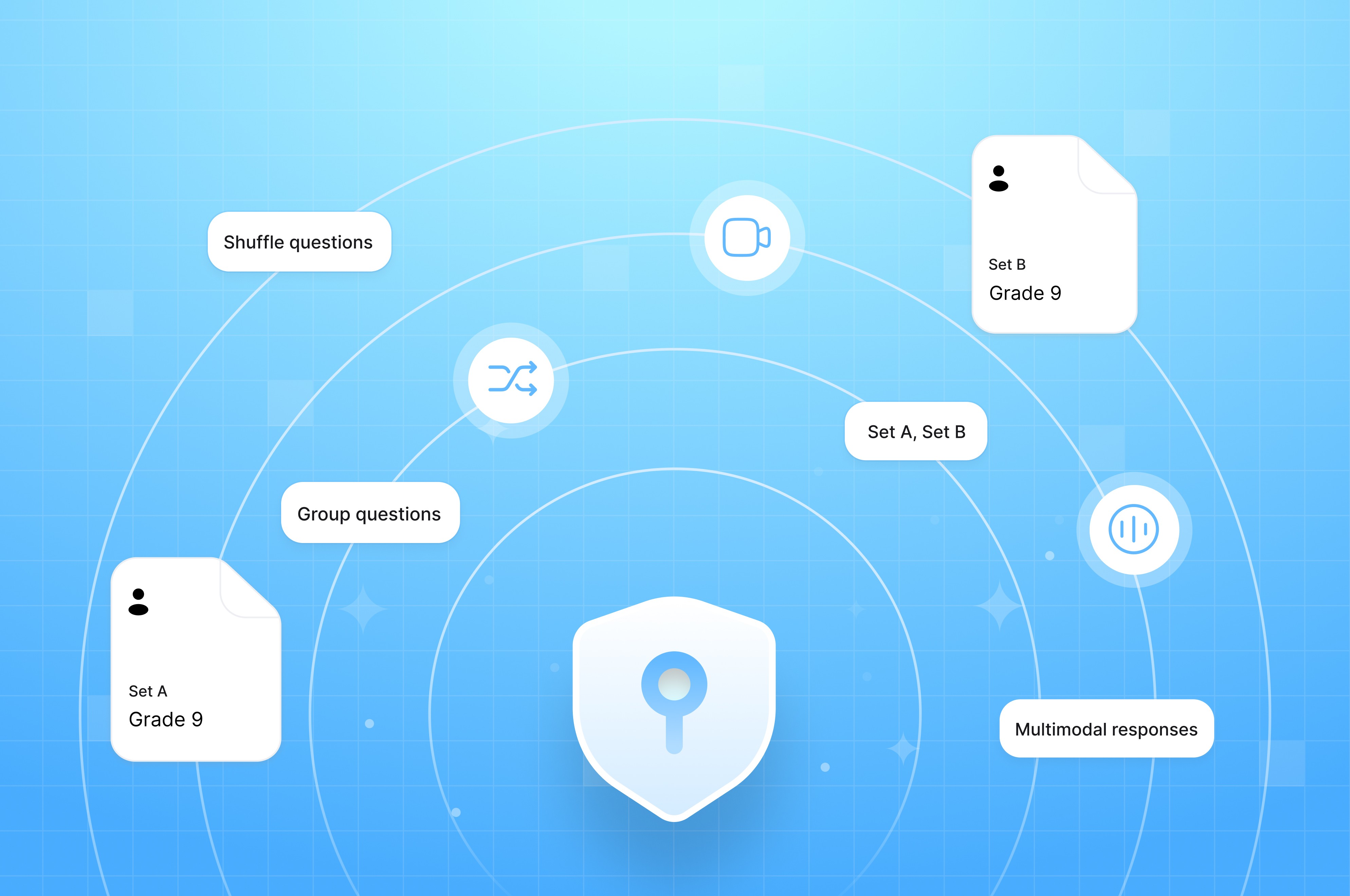
TL;DR: How schools can prevent cheating in online exams
Preventing cheating in online exams is not just about stricter monitoring. The strongest approach is to redesign assessments so answers are harder to copy, search, or outsource in the first place. Schools can reduce cheating by using smaller low-stakes assessments, multiple exam versions, question shuffling, show-your-work tasks, explanation questions, real-life scenarios, grouped case-based questions, multimodal responses, and prompts based on classroom context. Cheating prevention software supports these strategies through randomisation, uploads, secure delivery, and review logs, making it easier for teachers to protect academic integrity at scale.
Schools everywhere are asking the same question: how do you prevent cheating in online exams when students now have access to AI tools, shared group chats, answer banks, and search engines at all times?
The truth is, there is no single tool that solves the problem on its own. A lockdown browser can help. Monitoring tools can help. Clear policies matter too. But if the assessment itself is easy to copy, search, or outsource, students will always find a way around the rules.
That is why the strongest approach is not just stricter invigilation. It is smarter assessment design.
When teachers redesign exams to focus on reasoning, application, process, and personal response, cheating becomes harder, less useful, and much easier to detect. Add the right cheating prevention software on top of that, and schools can build a much more reliable system for academic integrity.
In this guide, we’ll look at 10 practical strategies schools can use to prevent cheating in online exams, especially in K-12 environments, and explain where software genuinely helps.
Why students cheat in online exams
Most students do not cheat because they are determined criminals. They cheat because the opportunity is easy, the pressure feels high, and the task feels like something that can be outsourced.
That usually happens when:
one exam carries too much weight
every student gets the same paper
questions rely too heavily on recall
answers can be found in seconds online
the final answer matters more than the thinking process
teachers have no visibility into how the response was produced
So if schools want to reduce misconduct, the goal is not only to catch cheating. The goal is to design assessments where cheating is less appealing and less effective in the first place.
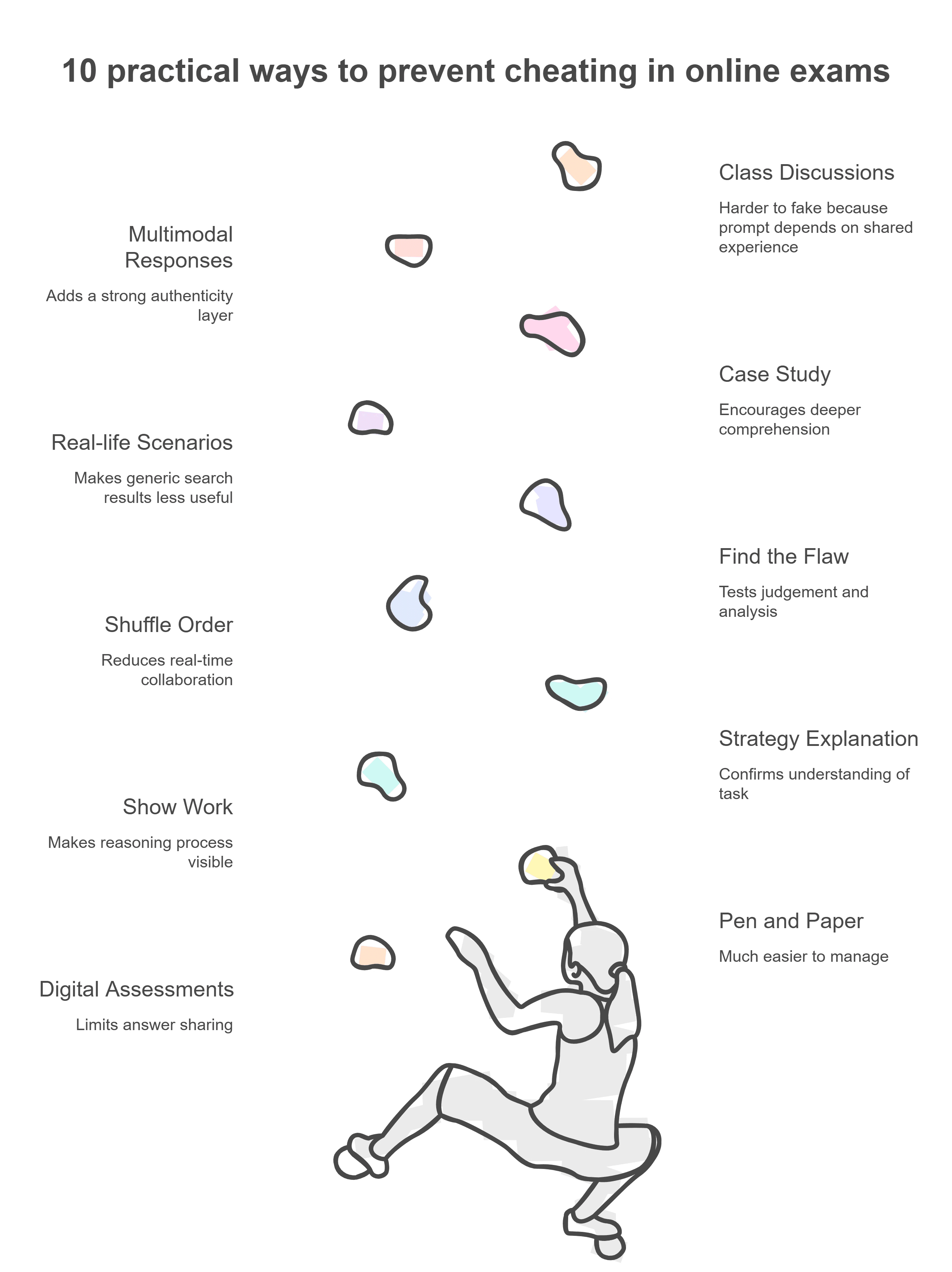
10 practical ways to prevent cheating in online exams
Patterns for assessment design | Ease with Digital assessments | Ease with Pen and paper assessments | Impact (to reduce cheating) | Remarks |
Switch to smaller, low-stakes formative assessments | Very high | Medium | High | Reduces pressure, spreads risk across the term, and makes student progress easier to verify over time. |
Offer multiple versions of the same exam | Very high | Low | High | Limits answer sharing and leaked answer key value; much easier to manage with question banks. |
Ask students to show or upload their work | High | Very high | Very high | Makes the reasoning process visible, which is especially useful in maths, science, and problem-solving subjects. |
Add a strategy explanation question | Very high | High | High | Helps confirm whether the student actually understood the task or only reproduced the answer. |
Shuffle question order and answer choices | Very high | Low | High | Reduces real-time collaboration and answer swapping; strongest for objective question types. |
Use “find the flaw” or critique tasks | High | High | Very high | Tests judgement, analysis, and correction skills, which are harder to outsource to AI or peers. |
Use real-life scenarios and judgement-based prompts | Medium | Medium | Very high | Makes generic search results and copied answers less useful because students must apply knowledge to a new context. |
Group questions around one case study or source | High | Medium | High | Encourages deeper comprehension by linking several questions to one shared text, case, or data set. |
Use multimodal responses such as audio, video, or image uploads | High | Low / N/A | Very high | Adds a strong authenticity layer and allows students to demonstrate understanding in their own voice or format. |
Base questions on class discussions or local context | High | High | Very high | Harder to fake because the prompt depends on shared classroom experience rather than generic online content. |
1. Replace one high-stakes exam with smaller, lower-stakes assessments
A single high-pressure exam often creates the strongest incentive to cheat. Smaller assessments spread across the term reduce that pressure and give teachers a more accurate picture of learning over time. This could mean short quizzes, exit tickets, timed reflections, mini oral tasks, or weekly concept checks instead of one large test at the end of a unit.
Why it works:
Students are less likely to risk cheating when each individual task carries less weight. It also becomes much harder to fake consistent understanding over several weeks.
Where software helps:
Good online exam software for schools can schedule recurring quizzes, automate marking for simple question types, and track progress without creating extra admin for teachers.
2. Create multiple versions of the same exam
If every student receives the exact same paper, answers can spread very quickly. That could happen through screenshots, messaging apps, whispered cues in a physical room, or shared documents outside class.
Creating two or three equivalent versions of the same assessment makes answer-sharing much less useful. This does not mean writing completely different exams from scratch. It can be as simple as:
changing the order of questions
swapping source materials
using different numbers or data sets
drawing from a question bank
rotating scenarios or examples
Why it works:
Even if students try to collaborate, they are not all looking at the same task in the same format.
Where software helps:
Cheating prevention software can generate variants automatically from a bank of approved questions, which saves a huge amount of manual effort.
3. Ask students to show their work, not just submit the answer
One of the most effective ways to reduce cheating is to reward process, not just output.
This matters especially in maths, science, economics, and any subject where reasoning can be demonstrated step by step. If a student only types the final answer, it is very hard to know whether they actually understood the task.
Instead, ask students to upload:
rough working
handwritten steps
diagrams
annotations
planning notes
draft structure
Why it works:
A copied answer is easy to submit. A clear explanation of how the student arrived at that answer is much harder to fake convincingly.
Where software helps:
Platforms that allow image uploads, QR-based work capture, or scanned rough work make this much easier in digital exams.
4. Add one mandatory explanation question
Sometimes the simplest design change has the biggest effect.
At the end of an exam, add one short question such as:
Which question did you find most difficult, and how did you solve it?
What strategy did you use to approach this task?
Which piece of evidence most influenced your answer, and why?
Why it works:
Students who completed the work themselves can usually explain their choices. Students who copied or outsourced the answer often struggle to describe the reasoning behind it.
This kind of question also gives teachers a useful authenticity check without needing full oral defence for every student.
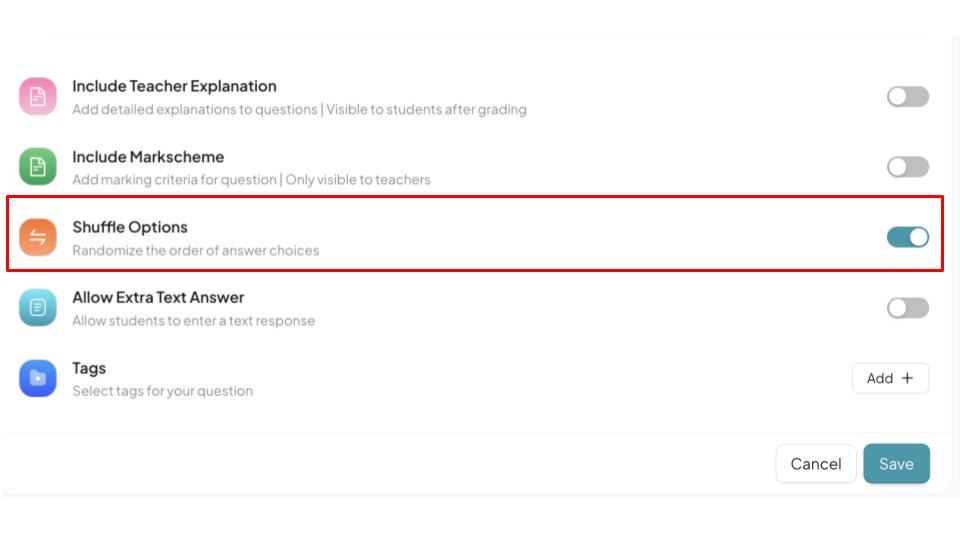
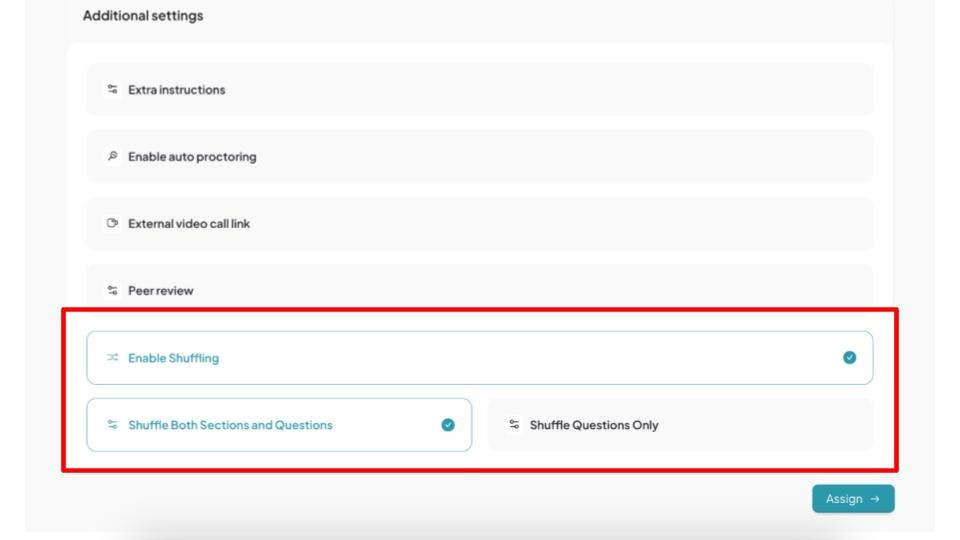
5. Shuffle question order and answer choices
This is one of the most basic but useful safeguards in online assessments.
If students sitting next to each other or messaging each other in real time see different question sequences and different answer option orders, collaboration becomes much harder.
Why it works:
It disrupts quick answer-sharing such as “the answer to number 7 is B” because question 7 may not even be the same question for another student.
Where software helps:
This is one area where cheating prevention software adds immediate value. Teachers can randomise questions and multiple-choice options with a single setting instead of manually building several versions.
6. Use “find the flaw” tasks instead of predictable essays
Traditional essay prompts are increasingly vulnerable to AI-generated responses, especially when the question is broad and generic. A stronger alternative is to give students a flawed answer and ask them to evaluate it.
For example:
identify weak reasoning
correct factual errors
improve the structure
explain what evidence is missing
rewrite one paragraph more effectively
Why it works:
This shifts the task from generic production to critical judgement. Students must engage with quality, reasoning, and subject knowledge, which is much harder to outsource well.
It also reveals whether they actually understand the standard of a good answer.
7. Use real-life scenarios that require judgement
Questions based only on recall are the easiest to search online. Questions based on real-life application are much harder to copy because they demand interpretation.
Instead of asking:
“What causes inflation?”
You might ask:
“If your city faced rising food prices and transport costs at the same time, which three local actions would you recommend and why?”
Why it works:
Students cannot rely on memorised definitions alone. They need to apply what they know to a fresh situation and justify their thinking.
This is one of the strongest ways to prevent cheating in online exams because it makes authentic understanding more valuable than a quick lookup.
8. Group questions around one shared source or case study
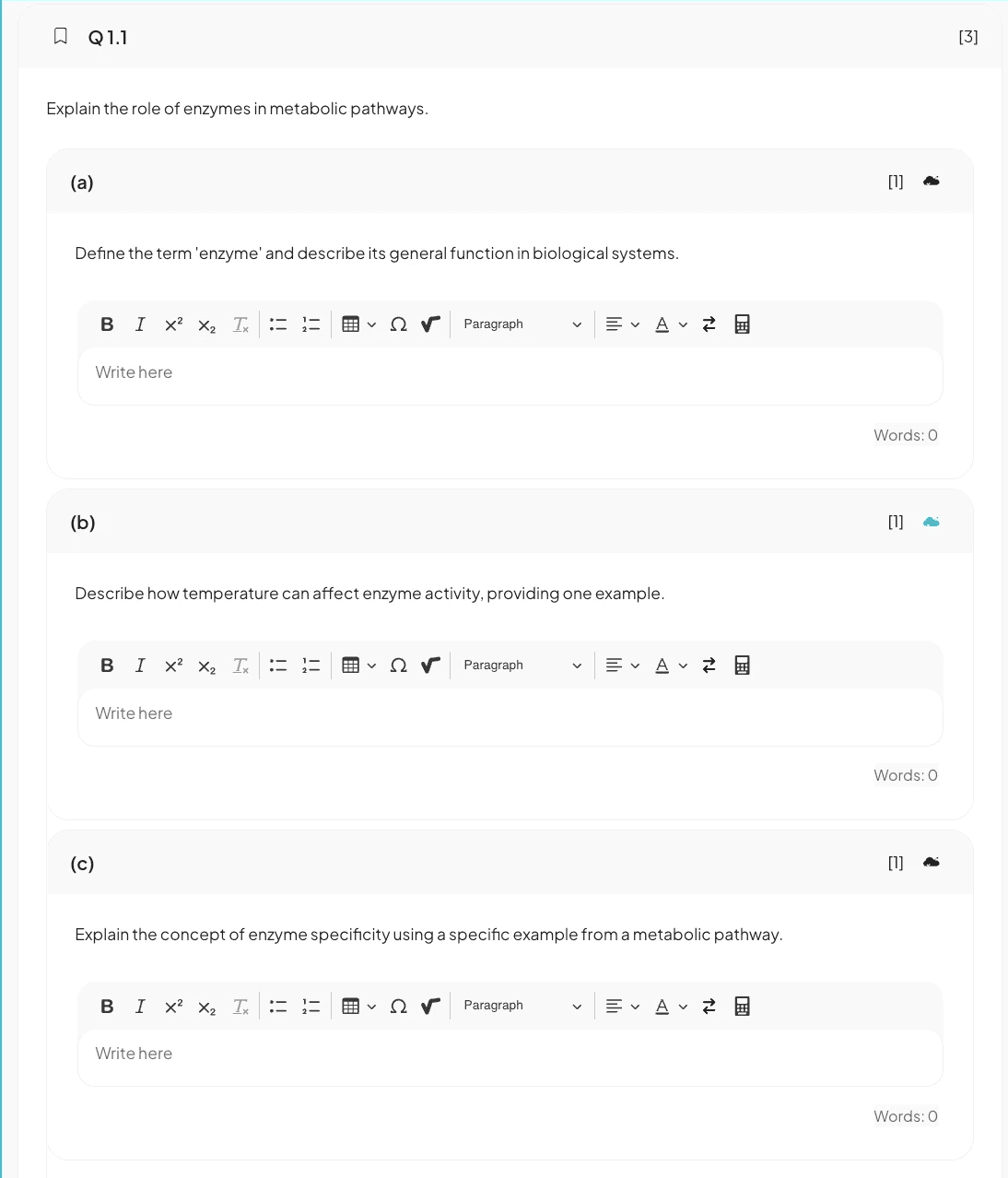
A case study, data set, reading passage, experiment summary, visual source, or historical extract can become the basis for several linked questions. This works well because students must stay with one source and think deeply about it instead of jumping from one disconnected fact to another.
Why it works:
Linked questions create continuity. Students who do not understand the core source usually struggle across the whole section, which makes shallow copying less effective.
Where software helps:
Some platforms support grouped or reading-comprehension style layouts that keep the source visible while students respond to related questions.
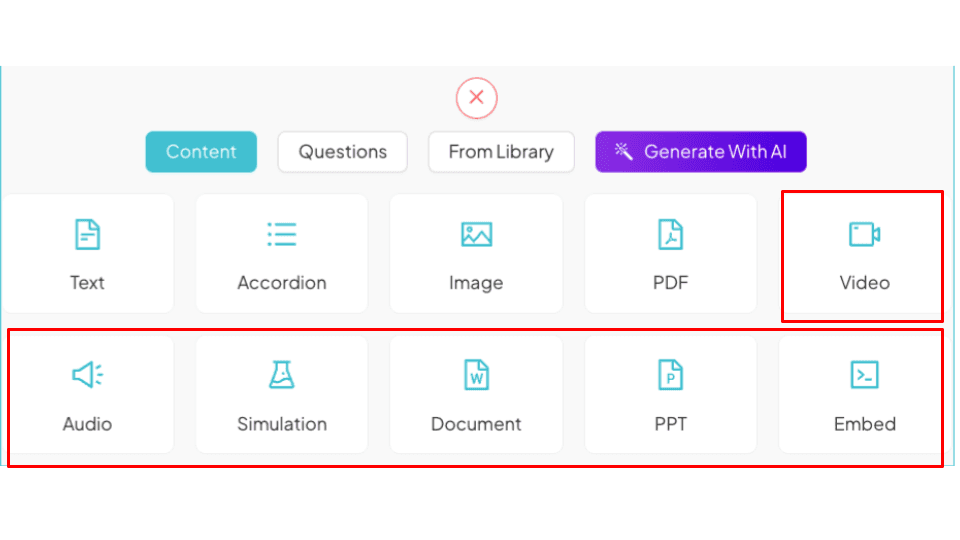
9. Use multimodal responses where appropriate
Not every student needs to prove understanding through typed text alone.
In some subjects, a short audio response, a video explanation, a labelled image, or a photographed mind map can reveal much more than a standard multiple-choice item.
Examples include:
recording a short explanation of a science concept
describing the steps in a language task
uploading a diagram
annotating an image
explaining a solution verbally
Why it works:
Multimodal tasks are harder to outsource and easier to personalise. They also give teachers a better sense of the student’s own voice and understanding.
Where software helps:
This is where digital assessment tools can really strengthen authenticity by allowing secure audio, video, and image submissions.
10. Build questions around your own classroom context
Generic prompts are easier for students and AI tools to answer. Localised prompts are much stronger.
You can refer to:
an in-class debate
a recent lab activity
a text discussed in class
a school event
a local issue
a specific experiment or project completed together
For example:
“Based on our discussion last Tuesday, which argument about renewable energy was most convincing, and why?”
Why it works:
The question depends on shared classroom experience, not just publicly available information. That makes it far more difficult to outsource.
It also rewards participation and real engagement.
What cheating prevention software should actually help schools do
Software should support better assessment design, not replace it. If a platform only promises surveillance, that is not enough. Schools need tools that help teachers build more authentic, flexible, and harder-to-game assessments from the start.
The most useful cheating prevention software usually includes:
question banks and paper variants
question and answer randomisation
timed sections
image or scratch-work uploads
audio and video responses
grouped questions around a shared source
audit trails and attempt logs
access controls
post-exam analytics
integrations with the school’s wider workflow
The key point is this: software works best when it reinforces good pedagogy. It should help schools run better assessments, not just stricter ones.
Are lockdown browsers enough?
Lockdown browsers still have a place. They can reduce casual switching, limit access to outside websites, and add a useful layer of control in formal settings. But they are not enough on their own.
If the exam is built around easy recall questions, shared answers, or generic essay prompts, students will still find ways around the system. They may use another device, collaborate externally, or rely on pre-prepared material. A stronger model is layered.
Use secure delivery tools where needed, but combine them with:
lower-stakes assessment design
authentic tasks
question randomisation
process-based marking
local classroom context
better post-exam review
That combination is far more effective than relying on one tool alone.
A more realistic approach to academic integrity
Academic integrity does not come from suspicion alone. It comes from assessment systems that are fair, thoughtful, and designed around real learning. When students feel that every task is only a memory test, cheating becomes easier to justify. When assessments ask them to think, apply, explain, and reflect, the shortcuts stop working so well.
That is why the best answer to online exam cheating is not just tighter control. It is better design.
Schools that want to prevent cheating in online exams should focus on two things at the same time:
Eedesigning assessments so copying is less useful
using software that makes those stronger designs easier to run at scale
That approach is more sustainable, more teacher-friendly, and much more likely to protect the real value of a student’s grade.
FAQ: Preventing cheating in online exams
What is the best way to prevent cheating in online exams?
The best approach is a layered one. Use smarter assessment design first, then add technology such as randomisation, secure delivery, work uploads, and review tools where appropriate.
Can cheating prevention software stop all cheating?
No. No software can eliminate cheating entirely. What it can do is reduce opportunities, make misconduct easier to spot, and help teachers run more secure assessments.
Are lockdown browsers enough to stop cheating?
Not by themselves. They can help with control, but they do not solve weak assessment design. If the questions are easy to search or share, students may still find ways around the browser.
What kinds of questions are hardest to cheat on?
Questions that require judgement, explanation, application, process, or local classroom context are usually much harder to cheat on than simple recall questions.
Why do smaller assessments reduce cheating?
Lower-stakes tasks reduce pressure and make it harder for students to fake performance consistently over time.
Articles
Read more from our blog

The AP exam MCQ playbook
A practical guide for creating AP exam MCQs aligned CED skills, with examples and distractor rationales.
5 min read

Best digital assessment platforms for IB DP schools in 2026
Comparing the best digital assessment platforms for IB DP? We review AssessPrep, Kognity, Exam.net, Revision Dojo, and Save My Exams across the criteria that matter to coordinators.
5 mins read