IB DP Computer Science new syllabus 2027: 10 changes to know
By Sidhi Baweja
Sidhi Baweja brings 11+ years of experience across consulting and edtech, with previous roles at KPMG and Accenture. At AssessPrep, she writes on IB assessment, digital examination workflows, and the operational side of running on-screen assessments for international schools.

The IB DP Computer Science new syllabus 2027 reaches its first sitting in May 2027, on the cohort that started Year 1 in August or September 2025. The changes are not cosmetic. The syllabus has been rewritten around two themes, Paper 3 has been removed, the case study has moved, the IA has been redesigned, and digital exams are now an option for any school that wants to take them.
Below are the ten changes consolidated with operational implications. This post sits inside the wider IB DP first assessment 2027 rotation, which covers Psychology, Design Technology, Visual Arts, the Extended Essay, and the Biology Paper 2 update.
TL;DR. The 2027 IB CS changes at a glance
Note: the right-hand column is school-level planning, not an IBO requirement. The official source for each change is the published IBO Computer Science guide on the Programme Resource Centre.
Key takeaway | What it means for your school |
Two themes (A: Concepts, B: Computational thinking) replace the old options structure; Java or Python only | Update Year 1 schemes of work; choose one language at department level |
Paper 3 is gone; the pre-seen case study moves into Paper 1 Section B for both SL and HL | Retire HL Paper 3 prep; brief SL students on the case study format |
Each exam paper is worth 35% (SL) or 40% (HL); the IA is 30% SL / 20% HL | Re-balance mock weightings to reflect the new split |
The computational solution IA caps documentation at 2,000 words and now requires a video | Build the video into the IA timeline; teach students what counts toward the word limit |
Digital exams are available from November 2026 in a dual-running window through 2029 | Decide digital or paper for your cohort, and lock that choice for the cycle |
What is the IB DP Computer Science new syllabus 2027?
IB DP Computer Science new syllabus 2027 is the redesigned IB Computer Science course for the cohort that began Year 1 in August or September 2025, with first assessment in May 2027. It introduces a two-theme framework, brings machine learning, object-oriented programming, and databases into the core for all students, sets up a 35-hour computational solution IA, and gives schools the option to sit exams digitally from November 2026. The final assessment for the legacy course is November 2026. The IBO releases the pre-seen case study and specimen papers for the 2027 Computer Science assessments through the Programme Resource Centre; check with your IB Coordinator for access and use them to calibrate mock papers.
For wider context on how IB DP assessment principles are organised, the coordinator's guide to IB DP assessment principles is a useful companion read.
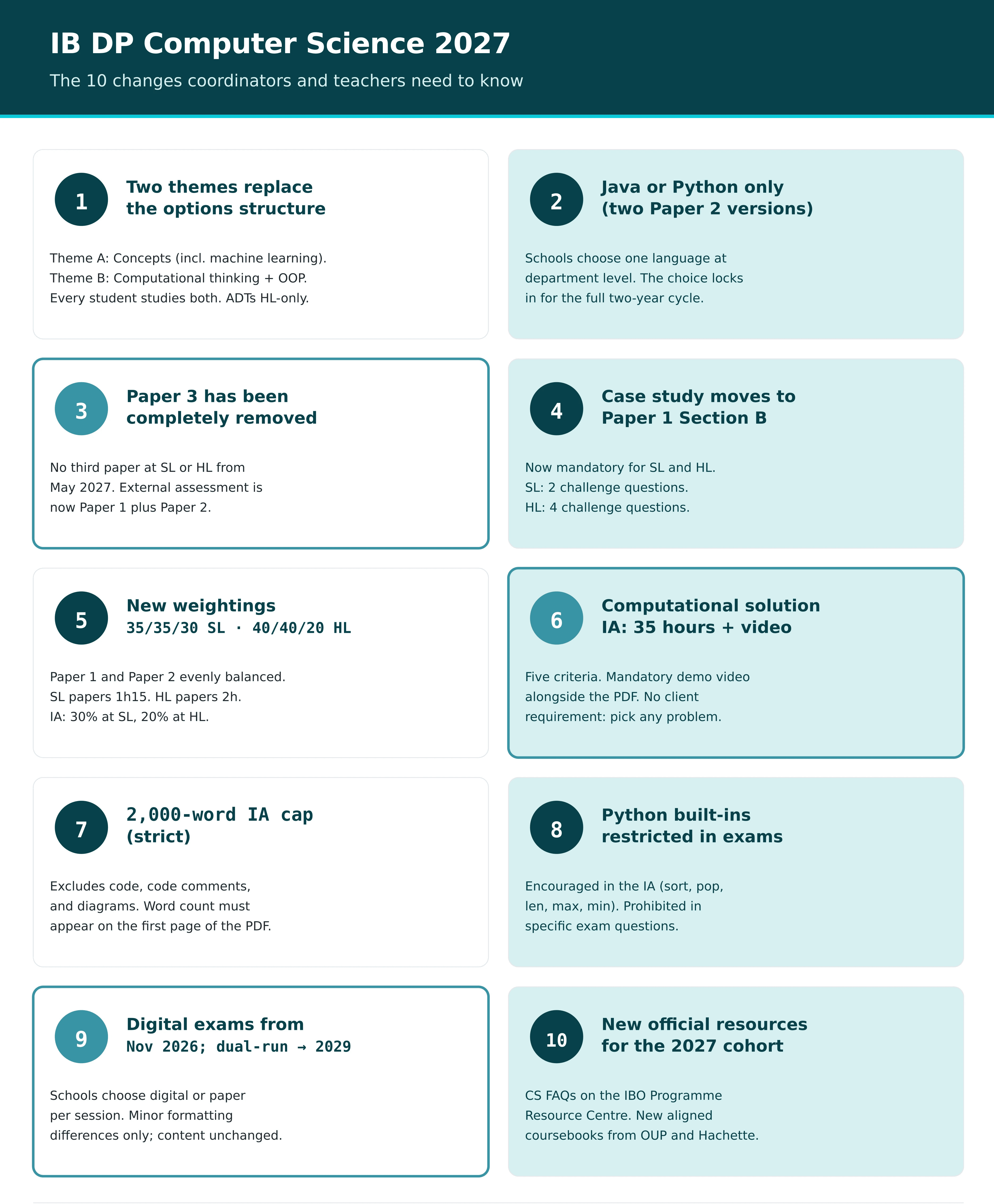
1. A two-theme framework replaces the old options structure
The new IB DP Computer Science course is built around two themes (Theme A: Concepts; Theme B: Computational thinking), and every student studies both.
Theme A. Concepts of computer science. Computer fundamentals, networks, databases, and a new focus on machine learning.
Theme B. Computational thinking and problem-solving. Computational thinking, programming, object-oriented programming, and abstract data types for HL only.
Object-oriented programming, databases, and machine learning are new core content for every student. Under the legacy options structure, OOP and databases were optional and machine learning was not in the guide at all. A Year 1 CS teacher now plans for all three from the first term. ADTs remain HL-only.
The next change is what students actually code in.
2. Java or Python, with two versions of Paper 2
The IB DP Computer Science new syllabus 2027 supports Java or Python only, with two separate versions of Paper 2 (one Java, one Python). Schools choose at department level. The choice runs through teaching, the IA, and the final exam, and locks in for the full two-year cycle.
Two SL Paper 2 questions also reappear on HL Paper 2, including one that tests algorithmic thinking without asking students to write or interpret code. The crossover signals what the IB is consistently assessing: the underlying reasoning, not just coding fluency.
The next change is the exam structure itself.
3. Paper 3 has been completely removed
Under the legacy syllabus, HL students sat a separate Paper 3 based on a pre-seen case study. From May 2027, Paper 3 no longer exists at SL or HL in IB DP Computer Science.
Revision hours schools used to ring-fence for Paper 3 prep can be redeployed to Theme B drilling or to the case study work that now sits inside Paper 1.
Where did the case study go?
4. The pre-seen case study moves into Paper 1 Section B, for both SL and HL
The pre-seen case study has moved into Paper 1 Section B and is now mandatory for both SL and HL students. Section A of Paper 1 carries extended-response questions linked to Theme A. Section B is the case-study section, based on a pre-seen scenario released ahead of the exam.
SL students answer short- and extended-response questions based on the case study, plus two challenge questions.
HL students answer questions based on the case study, plus four challenge questions.
The biggest shift sits with SL teachers, whose students now prepare for a case study their predecessors never faced. Legacy HL Paper 3 materials are only partially reusable because the question format has changed.
The case study is released on the Programme Resource Centre 12 months before the May session and 18 months before the November session, which gives coordinators real planning runway ahead of the mock cycle.
Mark split inside Paper 1. SL: Section A 38 marks, Section B 12 marks. HL: Section A 56 marks, Section B 24 marks. Section A still carries most of the paper, but Section B is now mark-bearing for SL students too.
Next, the marks.
5. New paper weightings and durations
Each exam paper is 1 hour 15 minutes at SL (35% each) and 2 hours at HL (40% each); the IA is worth 30% at SL and 20% at HL. Removing Paper 3 means external assessment is now evenly balanced between Paper 1 (Concepts) and Paper 2 (Computational thinking and problem-solving).
Component | SL | HL |
Paper 1 | 1 hour 15 minutes, 35% | 2 hours, 40% |
Paper 2 | 1 hour 15 minutes, 35% | 2 hours, 40% |
Internal Assessment | 30% | 20% |
A practice paper run in spring 2027 should reflect the 35/35/30 or 40/40/20 split, not the legacy distribution that included Paper 3.
The next change is the IA itself.
6. The IA is now the "computational solution": 35 hours, five criteria, mandatory video
The IB DP Computer Science computational solution IA runs to 35 hours and requires students to submit a video alongside their documentation. The new guide also names the IA explicitly as the "computational solution".
The solution is assessed against five updated criteria:
Problem specification. Define the problem and its scope.
Planning. Design the approach.
System overview. Describe how the solution fits together.
Development. Build the solution.
Evaluation. Assess what worked and what did not.
The video shows functionality and testing strategy: a 3-minute screen capture of, say, a habit-tracking app running through its test cases (input validation, edge cases, expected outputs) is the kind of artefact the IB now expects alongside the documentation. For projects where students need to demonstrate a workflow across more than one display, recording multiple screens can help capture the application, code, and testing process more clearly in a single demonstration.
The next change is how long the documentation can be.
7. A strict 2,000-word cap on the IA documentation
The IA documentation is capped at 2,000 words, explicitly excluding code excerpts, code comments, and diagrams. The documentation is a single PDF covering all five criteria, and the total word count must be clearly written on the first page so moderators can verify it.
That works out to roughly 400 words per criterion. The practical move is to teach word budgeting from week one of the project, not as a final-week problem.
The next change is more subtle and bites only in the final exams.
8. Python built-in functions are restricted in exam questions
During the IA, students may use Python built-in functions such as sort, pop, len, max, and min; specific exam questions will explicitly prohibit their use. The IB wants the exam to assess underlying algorithmic thinking, not the ability to call a pre-existing function.
Teachers need to practise both modes. In IA work, encourage built-ins; in timed exam practice, drop them and have students implement the underlying logic by hand. Students who only practise one mode will struggle when the exam paper signals which mode applies.
The next change is how students sit the exam itself.
9. Digital exams arrive from November 2026, with dual-running through 2029
Digital examinations become available to all IB World Schools from November 2026, with a dual-running phase across the 2027, 2028, and 2029 examination sessions. Schools transition at their own pace, choosing to administer the new CS exams digitally or stay on paper. The core paper structure and content are the same across modes, with only minor digital-format adjustments such as the removal of line and paragraph numbering in some source texts.
The final change is the lightest, but worth knowing.
10. New official support resources for the 2027 cohort
New IB-published support resources for the 2027 cohort include Computer Science FAQs on the Programme Resource Centre and new aligned coursebooks from Oxford University Press and Hachette Learning.
Computer Science FAQs on the Programme Resource Centre, under the "In practice" section. These clarify questions raised during the 2025 curriculum workshops.
New official coursebooks aligned to the 2027 assessments from Oxford University Press and Hachette Learning. The legacy editions do not cover Themes A and B in the new structure.
The budget conversation is simple: the legacy editions are out and the new aligned editions are in before Year 2 of the new cycle. Legacy past papers are also of limited value because the paper format and weightings have changed.
That covers every change. Here is how AssessPrep fits in.
How AssessPrep supports the 2027 IB CS transition
AssessPrep is an AI-powered digital assessment platform used by 800+ international schools across 85+ countries. The most relevant capability for the 2027 transition is the IB DP question bank inside the AssessPrep IB DP platform: 18,000+ items tagged against the IBO subject criteria. Tags update when the IBO publishes a redesigned guide, so Computer Science items can be filtered by Theme A or Theme B and by Java or Python without manual re-tagging.
AI authoring extends the bank for Computer Science specifically: teachers can generate items in the new Paper 1 Section B case-study format and in the "built-ins prohibited" exam style from change 8.
For schools weighing digital readiness for May 2027, the Ecolint Geneva case study covers the rollout end to end.
Preparing your CS cohort for 2027? Run mock papers in the new format on AssessPrep’s on-screen assessment platform, start a 30-day free trial.
Conclusion
The May 2027 Computer Science sitting is a full syllabus overhaul. The content has been rewritten, with machine learning added and OOP and databases pulled into the core for every student. The exam structure has been redesigned, with Paper 3 gone and the case study now in Paper 1 for both SL and HL. The IA has a new name, more hours, a tighter word cap, and a video requirement. Digital exams are available, with three sessions of dual-running to choose your moment.
Treat the next twelve months as a redesign window: audit legacy materials, retire Paper 3 prep, refresh the coursebook order against the new Theme A and Theme B editions, and book your CS teachers onto the IBO workshops.
Key Takeaways
The new IB DP Computer Science course has two themes (A: Concepts; B: Computational thinking), with Java or Python locked at the department level and two versions of Paper 2. Machine learning, OOP, and databases are now core content for every student.
Paper 3 has been removed; the pre-seen case study now sits in Paper 1 Section B for both SL and HL.
The computational solution IA runs to 35 hours, caps documentation at 2,000 words excluding code and diagrams, and requires a video alongside the PDF.
Exam questions can prohibit Python built-in functions even though the IA encourages them. Students should practise in both modes.
Digital exams are available from November 2026 in a dual-running window through 2029; schools choose digital or paper for each sitting.
Frequently asked questions
What is IB DP Computer Science new syllabus 2027?
IB DP Computer Science new syllabus 2027 is the redesigned IB Computer Science course for the cohort that began Year 1 in August or September 2025, with first assessment in May 2027. It introduces a two-theme framework (Theme A: Concepts; Theme B: Computational thinking), brings machine learning, OOP, and databases into the core for all students, sets up a 35-hour computational solution IA, and gives schools the option to sit exams digitally from November 2026.
Is Paper 3 still part of IB Computer Science from May 2027?
No. Paper 3 has been completely removed from IB DP Computer Science for first assessment in May 2027 at both SL and HL. External assessment is now Paper 1 (Theme A plus the pre-seen case study) and Paper 2 (Theme B, with separate Java and Python versions). Any legacy HL Paper 3 prep materials no longer apply.
Do SL students prepare for the pre-seen case study?
Yes. The pre-seen case study has moved from the legacy HL-only Paper 3 into Paper 1 Section B and is now mandatory for both SL and HL students. SL students answer questions on the case study plus two challenge questions; HL students answer questions on the case study plus four challenge questions.
How long is the new IB Computer Science IA?
The new IB DP Computer Science IA, called the computational solution, runs to 35 hours of class time. Students identify a problem, design and build a software solution, and submit a single PDF documenting the project alongside a video that demonstrates functionality and testing. The IA is worth 30% at SL and 20% at HL.
What is the IA word limit for IB Computer Science 2027?
The IB has set a hard maximum of 2,000 words for the IA documentation, which is a single PDF covering all five criteria (Problem specification, Planning, System overview, Development, Evaluation). The 2,000-word cap explicitly excludes excerpts of code, code comments, and diagrams. The total word count must be clearly written on the first page of the PDF.
Can my school keep using paper exams in 2027?
Yes. Digital examinations become available to all IB World Schools from November 2026, but the IB operates a dual-running phase during the 2027, 2028, and 2029 examination sessions. Schools can choose to administer the new Computer Science exams digitally or continue with paper-based exams. The decision can be made per sitting, giving schools time to plan the transition.
How does AssessPrep support the IB DP Computer Science 2027 transition?
AssessPrep is an AI-powered digital assessment platform used by 800+ IB schools across 85+ countries. The IB DP question bank holds 18,000+ items tagged against the IBO subject criteria, with Computer Science items filterable by Theme A or Theme B and by Java or Python. AI authoring lets teachers generate new items in the Paper 1 Section B case-study format and in the 'built-ins prohibited' exam style. This is a different product category to general subject revision sites such as Save My Exams; AssessPrep is the assessment delivery and authoring platform schools use to run their own mocks and IAs.
What are the mark splits and paper durations for IB DP Computer Science 2027?
At SL, both Paper 1 and Paper 2 run for 1 hour 15 minutes. Paper 1 Section A is worth 38 marks and Section B (case study) is worth 12 marks. At HL, both Paper 1 and Paper 2 run for 2 hours. Paper 1 Section A is worth 56 marks and Section B (case study) is worth 24 marks. Each paper carries 35% of the SL final grade and 40% of the HL final grade. The IA contributes 30% at SL and 20% at HL.
Articles
Read more from our blog

6 digital assessment tools international schools actually use in 2026
Six digital assessment tools for IB, Cambridge and Edexcel teachers, sorted by create, deliver or mark, with what each one cannot do.

10 academic integrity examples for international schools
10 real academic integrity examples for IB, Cambridge & Edexcel schools: what honest work looks like in practice, plus the classroom strategy behind each one.
3 mind read