IB Exams 2027: May & November Dates and Schedule
By Sidhi Baweja
Sidhi brings 11+ years of experience across consulting and edtech, with previous roles at KPMG and Accenture. Now at AssessPrep, she combines her passion for education with deep expertise in IB DP and IB MYP assessment design to help international schools transition to digital-first evaluation.

Download Resource!
The cohort that started Year 1 of the IB Diploma Programme in August or September 2025 sits the new papers in May 2027. Most schools are piecing together what is changing one subject at a time.
Here is the consolidated view in one place.
IB DP first assessment 2027 refers to the May 2027 examination session, when the cohort that began their two-year course in August or September 2025 is examined for the first time on the redesigned Psychology, Computer Science, Design Technology, Visual Arts, and Extended Essay guides, along with the revised Biology Paper 2 mark structure. Below is what is changing in each subject, why this rotation matters, and a 12-month rollout timeline schools can adapt for their own planning.
TL;DR. The 2027 IB DP changes at a glance
Note: the right-hand column lists school-level planning suggestions, not IBO requirements. The official source for each change is the published IBO subject guide.
Key takeaway | Suggestion for your school |
|---|---|
Five DP subjects have first assessment in May 2027, plus a Biology Paper 2 mark change | Treat this as multiple parallel transitions in one window |
Psychology, Computer Science, and Design Technology have IA redesigns | Consider scheduling the new IAs on the Year-2 calendar early |
Visual Arts schools must use the new VA6/CAF form for May 2027 submissions | A VA6/CAF dry-run during the spring mock cycle helps surface issues early |
The Extended Essay now offers Subject-Focused or Interdisciplinary pathways with one final reflection on a redesigned RPF | Brief EE supervisors before students choose their pathway |
Biology Paper 2 Section B no longer awards a separate mark for the structure of extended-response answers | Updating revision packs and re-tagging question banks may help students focus on subpart-level content |
What’s changing for IB first assessment 2027.
IB DP first assessment 2027 is the May 2027 examination session, when students who began their redesigned two-year course in August or September 2025 sit the new papers for the first time. The change covers five Diploma Programme subjects plus one Biology Paper 2 format adjustment.
The five subjects with first assessment in May 2027 are Psychology, Computer Science, Design Technology, Visual Arts, and the Extended Essay, all of which had first teaching from August 2025. The sixth change is the IB DP Biology Paper 2 Section B mark redistribution, also from May 2027. The IBO publishes general curriculum-update news on the public ibo.org site; the detailed subject guides for educators are hosted on the password-protected Programme Resource Centre (PRC), which schools access through their IBO credentials. Before redesigning a single task for 2027, ground your team in the IB assessment principles that underpin every DP assessment decision. For the full subject breakdown, see the IB DP Computer Science new syllabus 2027, 10 changes to know.
When are the IB DP May 2027 exams? Full schedule and key dates
IB May 2027 exams: 23 April 2027 to 19 May 2027 (no exams on 1 May).
The examination schedule in 2027 will start on Friday 23 April 2027, and end on Wednesday 19 May 2027 (with no exams on 1 May), subject to confirmation. In the IBO's own words: "The examination schedule in 2027 will start on Friday 23 April 2027, and end on Wednesday 19 May 2027 (with no exams on 1 May), subject to confirmation in 2025." The IBO has since confirmed these dates.
Below you'll find the full IB exams 2027 schedule, the November 2027 session window, exact paper start times, and what's changing for first assessment 2027, so coordinators, teachers, and students can plan the year with confidence. Bookmark this page: we update it the moment the IBO releases the subject-level timetable grid.
Key-dates table
Item | Date / detail |
|---|---|
May 2027 session — exams begin | Friday 23 April 2027 (subject to confirmation) |
May 2027 session — exams end | Wednesday 19 May 2027 (subject to confirmation) |
Session | First assessment 2027 (new/updated subject guides apply) |
November 2027 session | Subject to IBO confirmation |
Dates follow the IB’s published examination schedule. Confirm subject-level paper times on the official IB timetable.
Why May 2027 matters for the May 2027 cohort
The May 2027 cohort is the first group examined under five redesigned subject guides at the same time, plus the revised Biology Paper 2 mark structure. There are no past papers under the new criteria yet, and the IBO has indicated that authentic student examples for the new Extended Essay assessment criteria will be published following the 2027 session.
For schools, that means coordinators are working through five separate subject transitions in parallel rather than sequentially. The November 2027 cohort follows the same redesigned guides, so November-session schools are tracking the same set of changes shifted by six months. We covered the immediately preceding round of changes in our IB DP 2026 assessment changes guide, and the broader digital-exam transition in the IB DP digital exams 2026 transition guide; both pair naturally with this 2027 reference.
1. IB Psychology: new framework, new IA, redesigned exams
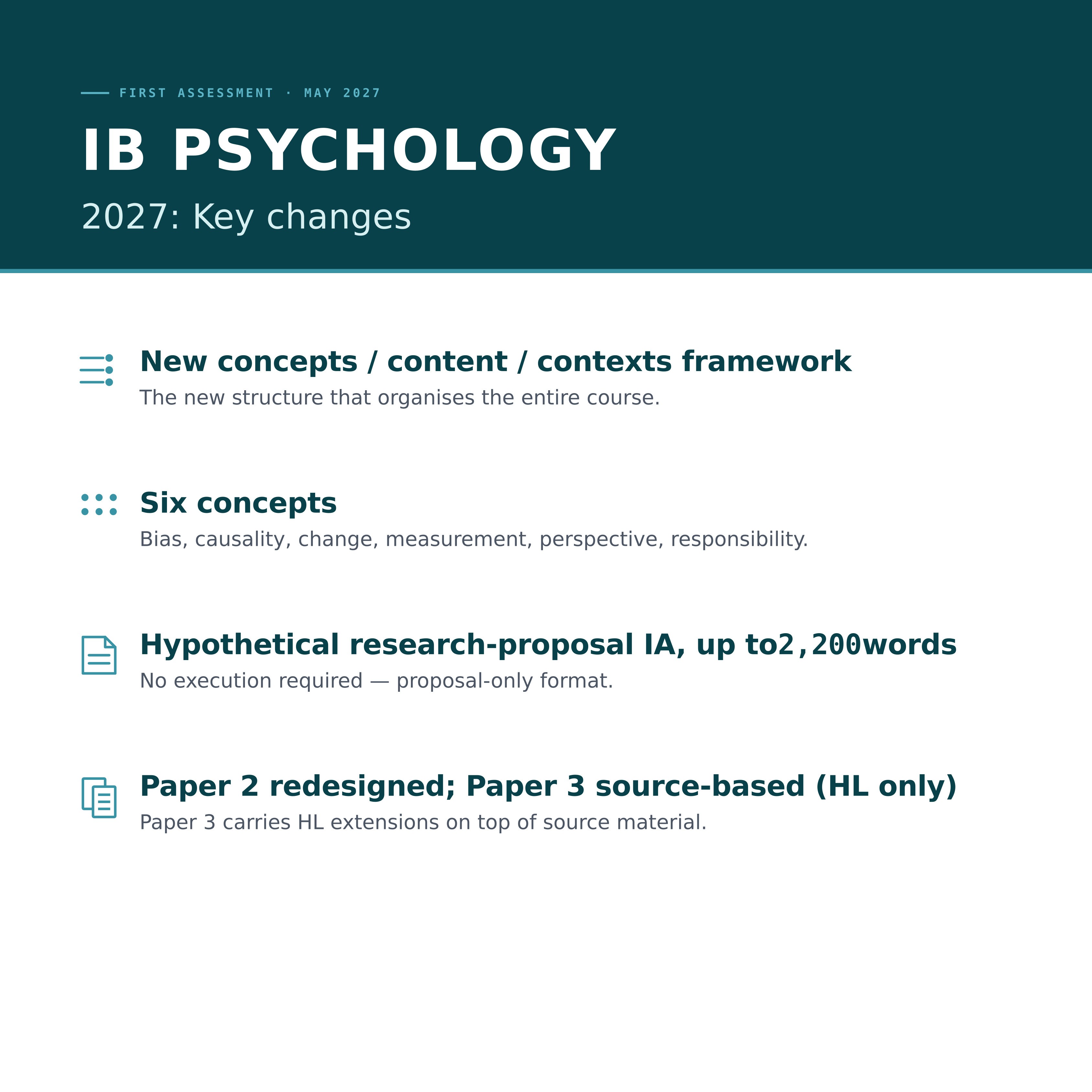
The new IB DP Psychology guide replaces the old "Core + Options" structure with an integrated framework built around three pillars: concepts, content, and contexts. The changes touch every component of the course, including a brand new IA, new HL extensions, and a complete redesign of the external examinations.
Concepts, content, and contexts. Six key concepts (bias, causality, change, measurement, perspective, and responsibility) run throughout the entire course. The content covers the biological, cognitive, and sociocultural approaches alongside research methodology. Students apply their learning across four mandatory contexts: health and well-being, human development, human relationships, and learning and cognition.
A brand-new IA. Students no longer conduct and report on an experimental study. The IA is now a hypothetical research proposal of up to 2,200 words, in which students design a study to investigate a "population of interest" using one of the research methods covered in their class practicals.
New HL extensions. Higher Level students no longer simply study additional Options. The HL course is extended with specific content on the role of culture, motivation, and technology in shaping human behaviour, plus in-depth data analysis and interpretation.
Redesigned external examinations. Paper 2 Section A tests knowledge of the research methodologies covered in class practicals; Section B requires students to read an unseen research study and evaluate it using the course's new key concepts. Paper 3 (HL only) is now a source-based exam focused on the HL extensions, with students interpreting graphs, analysing data, and synthesising findings. The IBO's public-facing Psychology subject updates page summarises these changes; the authoritative subject guide lives in the password-protected Programme Resource Centre (PRC) for educators.
2. IB Computer Science: two themes and the 35-hour computational solution IA
The new IB DP Computer Science course is built around two themes: Concepts of computer science (Theme A) and Computational thinking and problem-solving (Theme B). The IA is replaced with a 35-hour project called the computational solution, and students complete a 10-hour collaborative sciences project alongside it. Java and Python are both supported.
The two themes replace the old options-based syllabus. Databases, object-oriented programming, and the case study are now part of the standard course for all students; one HL-only unit (Abstract Data Types) remains for HL students.
The 35-hour computational solution is the redesigned internal assessment. Students take a real problem, design a solution, build it, and evaluate it from end to end. There is no longer a requirement to involve a client, so candidates can explore any topic that interests them. The IA contributes 30% of the final grade at SL and 20% at HL.
The 10-hour collaborative sciences project sits alongside the IA and is shared across the Group 4 sciences, so departments running Group 4 already have a process to adapt.
3. IB Design Technology: three thematic strands and the 50-hour design project
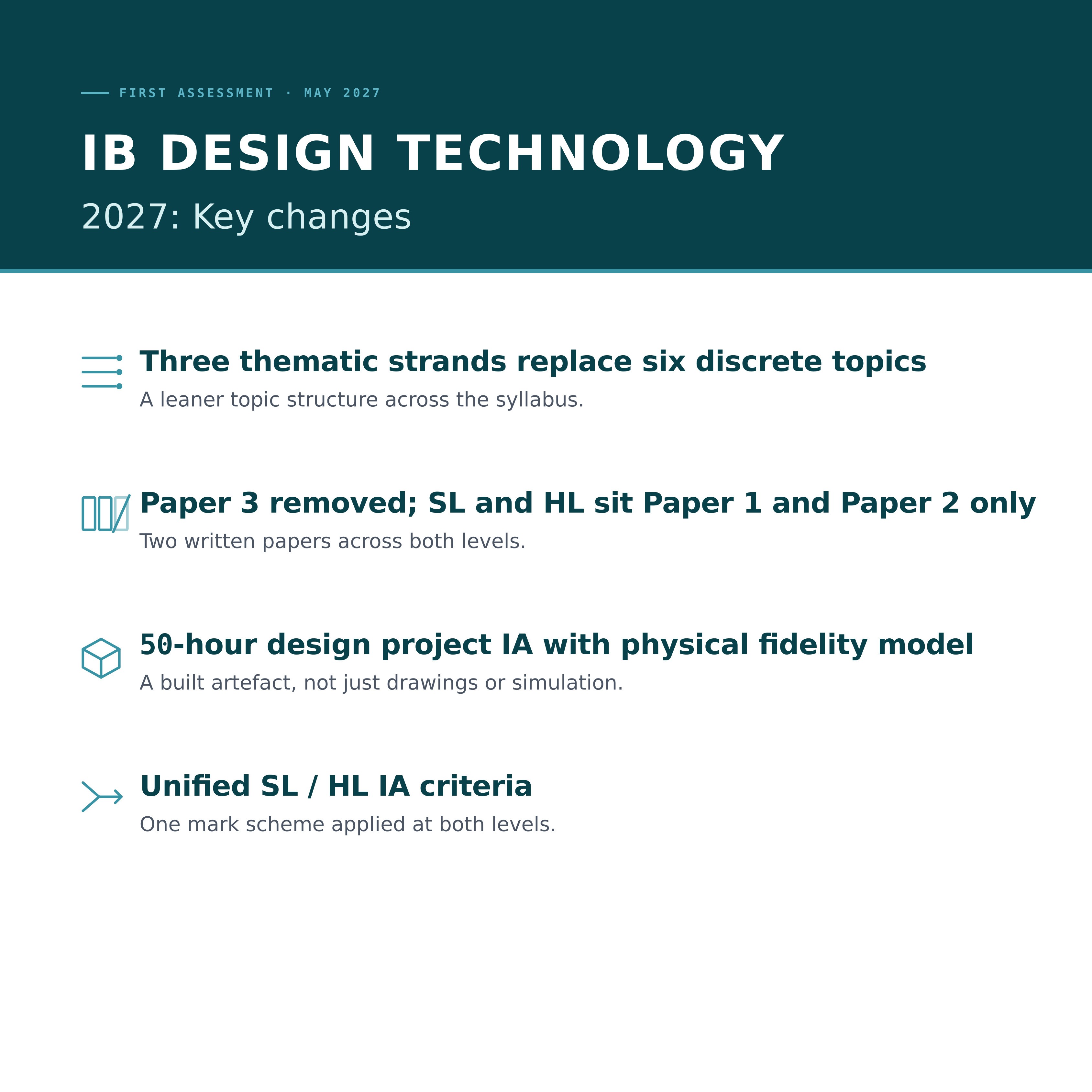
The new IB DP Design Technology guide replaces six discrete topics with three interconnected themes, removes Paper 3 entirely (SL and HL students sit only Paper 1 and Paper 2), and introduces a 50-hour design project IA in which students identify, analyse, evaluate, and redesign an existing product. SL and HL now share unified IA criteria.
The three themes integrate inclusive design, sustainability, and circular-economy thinking into the main course rather than parking them in HL options. Students are encouraged to use CAD software, rapid prototyping, AI tools, and hands-on prototyping methods.
Removing Paper 3 simplifies the external assessment structure: both SL and HL students sit only Paper 1 and Paper 2. The 50-hour design project requires students to produce a physical fidelity model used for testing and evaluation, alongside the documented design-thinking process, problem analysis, and evaluation.
The unified SL/HL IA criteria streamline moderation: SL and HL students are assessed against the same set of IA criteria, with HL students continuing to engage with HL-specific content elsewhere in the course.
4. IB Visual Arts: art-making as inquiry and the new VA6/CAF form
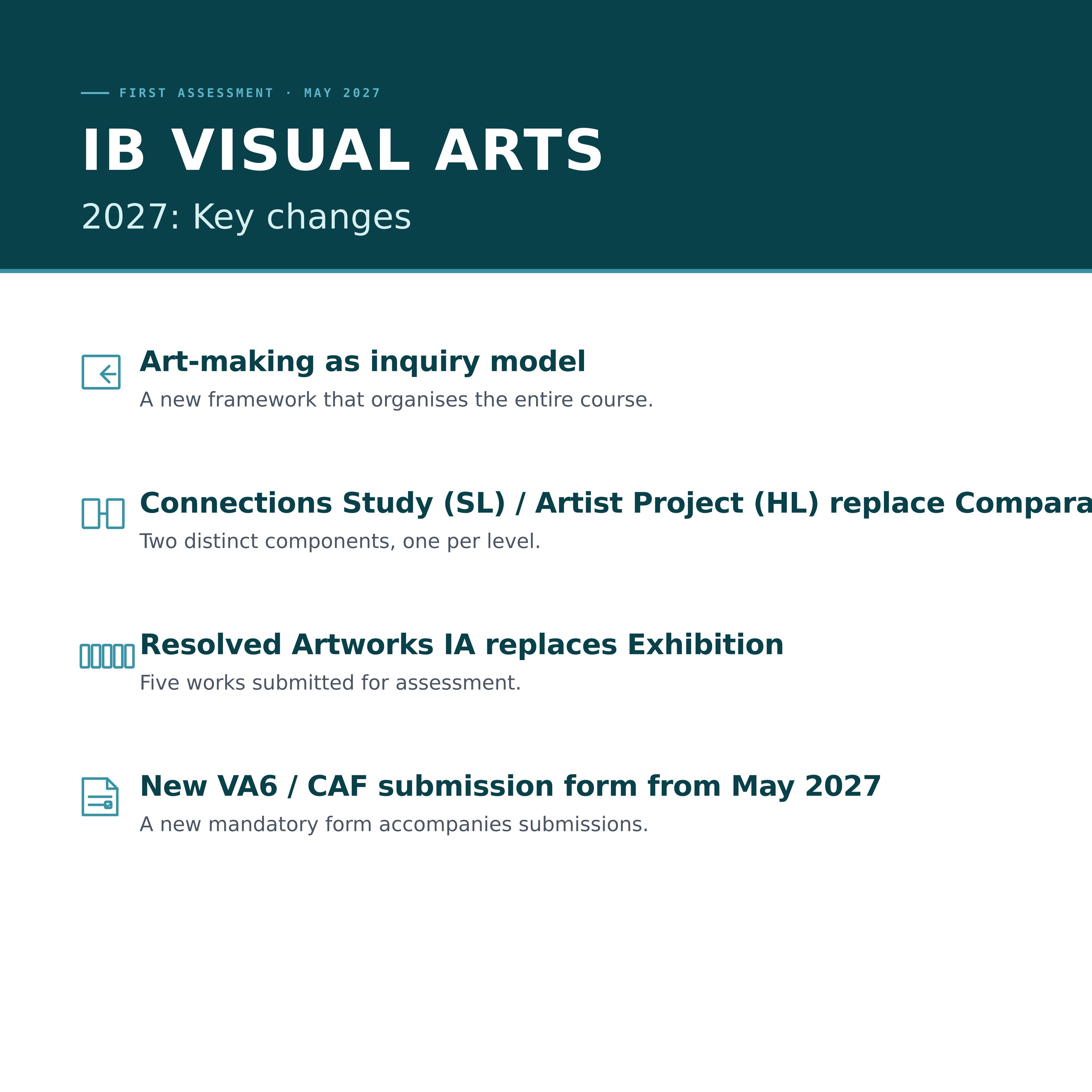
The new IB DP Visual Arts guide centres an "art-making as inquiry" model, replaces the Comparative Study with the Connections Study (SL) or Artist Project (HL), and from May 2027 schools must submit student work using the new VA6/CAF form. SL and HL now have meaningfully different external assessment tasks.
The three-task model retains three components but redistributes weighting. The Art-making Inquiries Portfolio (40% SL, 30% HL) replaces the old Process Portfolio with a stronger emphasis on inquiry, and is capped at 15 screens and 3,000 words. SL students complete the Connections Study around one of their resolved artworks (10 screens, 2,500 words). HL students complete the Artist Project, a substantial standalone work supported by a multi-screen PDF and a short video showing the realised project in context.
The Resolved Artworks IA replaces the old Exhibition. SL students submit five resolved artworks with a rationale of up to 700 words. HL students submit five resolved artworks selected from a wider documented body of at least eight, supported by a rationale and five artwork texts (1,000 words total) that situate each piece within the student's practice.
The VA6/CAF form is the operational change schools need to plan for. From May 2027 it replaces the previous submission workflow. The IBO's public-facing Visual Arts subject updates page summarises these changes; the authoritative subject guide and the VA6/CAF form template are held on the password-protected Programme Resource Centre (PRC) for educators.
5. Extended Essay: Subject-Focused vs Interdisciplinary pathways
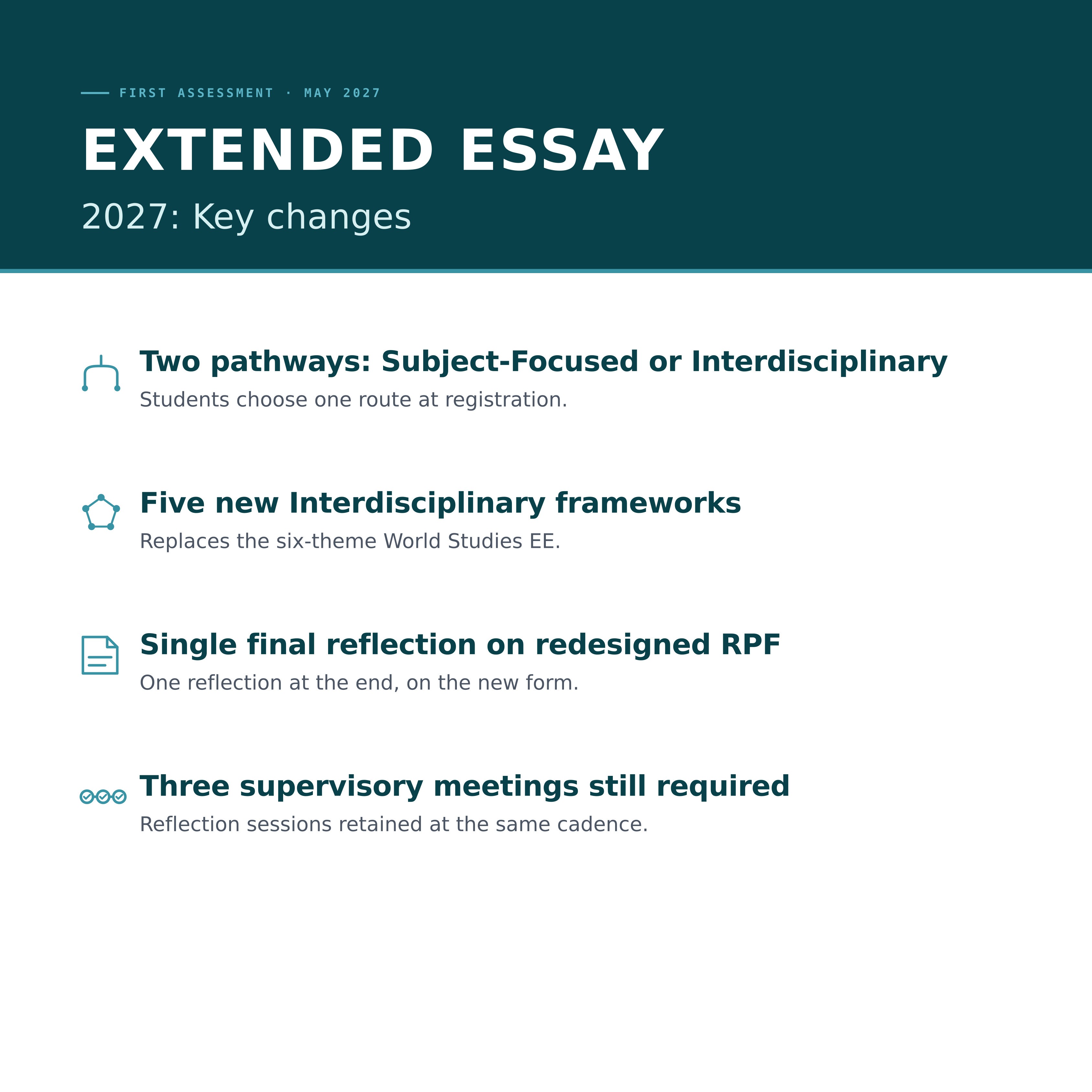
From May 2027, the IB DP Extended Essay offers two pathways: a Subject-Focused EE that goes deep into one DP subject, and a new Interdisciplinary EE that bridges two subjects through one of five frameworks. The three RPPF reflections are replaced with a single final reflection captured on a redesigned RPF (Reflections on Planning & Progress Form). Three supervisory meetings are still required.
The Interdisciplinary EE replaces the old World Studies EE. The five new frameworks (a different structure to the old World Studies EE's six global themes) act as the conceptual lens through which students integrate their two chosen subjects to answer the research question. Most students will continue to choose the Subject-Focused pathway.
The redesigned criteria place greater emphasis on developing a strong line of argument. The single final reflection consolidates what were previously three RPPF entries. Authentic student examples illustrating how the new assessment criteria are applied will be published by the IBO following the 2027 session.
6. IB Biology Paper 2 Section B: the structure mark redistribution
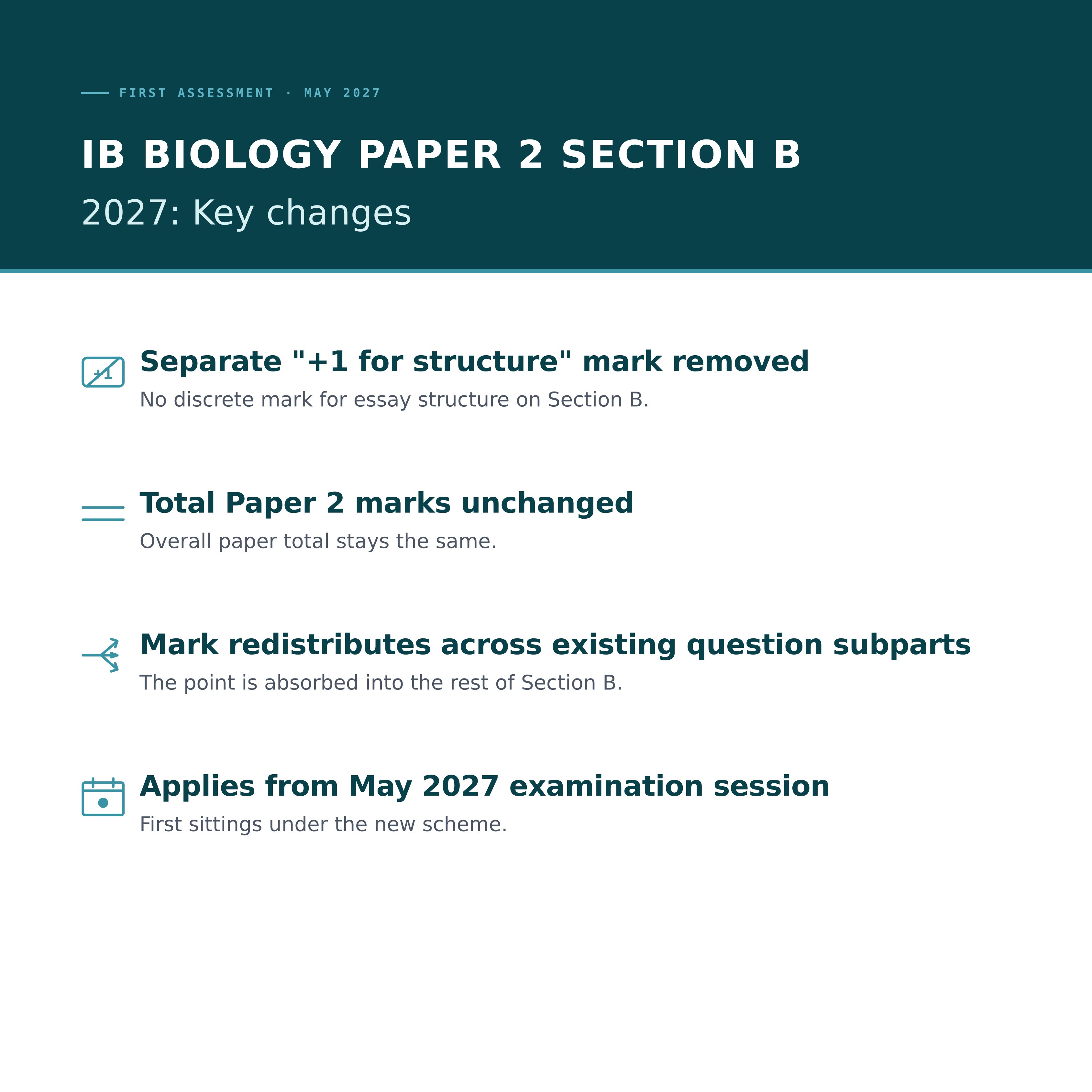
From the May 2027 examination session, IB DP Biology Paper 2 Section B no longer awards a separate mark for the structure of extended-response answers. The total marks for Paper 2 are unchanged; the redistributed mark is spread across the existing question subparts.
This is a paper-format change applied within the current Biology syllabus (which had first assessment in May 2025). The Biology subject content is unchanged. Paper 1 remains as published. Paper 3 was removed from Biology when the current syllabus launched, so it is not part of the 2027 change set.
Section B still asks students to write extended responses; they no longer earn a discrete +1 for structuring those answers. The mark moves into the subparts.
A 12-month rollout timeline (school-level suggestions, not IBO requirements)
The timeline below is a school-level planning suggestion compiled to help DP coordinators sequence the changes. The IBO does not mandate any of these specific dates or actions; coordinators should adapt the timeline to their own academic calendar and school context.
Term 3 of academic year 2025-26 (April to June 2026). Audit which of the affected subjects your school offers, brief heads of department, save the IBO subject-guide downloads internally, and book staff onto IBO and partner webinars on each redesigned subject.
Term 1 of academic year 2026-27 (July to September 2026). Publish new schemes of work, standardise the four-context plan in Psychology, sequence the 35-hour Computer Science IA on the Year-2 calendar, sequence the 50-hour Design Technology IA, and confirm Paper 3 has been removed from any DT revision schedule.
Terms 2 and 3 (October 2026 to February 2027). Run the mock-exam cycle under the new criteria. Moderate IAs against the unified Design Technology criteria. Run a VA6/CAF dry-run. Brief EE supervisors on the new RPF and confirm each Year-2 student's pathway choice.
Term 4, the live session (March to May 2027). Final mock cycle. Brief Biology students on the Paper 2 Section B mark distribution. Run the VA6/CAF submission workflow. Hold the EE final reflection deadline. Administer Paper 1 and Paper 2 as scheduled.
This calendar is intended as a starting point. Adapt it to your school's term structure, leadership review cycle, and existing assessment workflow.
How AssessPrep supports the 2027 transition
AssessPrep is an AI-powered digital assessment platform used by 800+ international schools across 85+ countries. The most relevant capability for the 2027 transition is the IB DP question bank: 18,000+ questions tagged against the IBO subject criteria, with tags updated when each redesigned guide is published. Schools that start early have a smoother shift, our guide to transitioning to IB digital exams walks coordinators through the move step by step.
Curriculum-aligned tagging. Every question in the AssessPrep IB DP bank is tagged against the current subject guide. When the IBO publishes a redesigned guide, the tags are updated against the new criteria, so the Psychology bank reflects the new concepts/content/contexts framework, the Computer Science bank reflects the two themes, and the Biology bank reflects the Paper 2 Section B mark redistribution. Teachers do not re-tag manually; the metadata moves with the guide.
AI authoring extends the bank. Teachers can generate new items inside the platform tied to the new key concepts in Psychology, the computational solution IA brief in Computer Science, or the redesigned Visual Arts Connections Study prompts. Each AI-authored item lands in the bank with the same tagging structure as the seed questions.
Planning on-screen assessments for the 2027 cohort? Run mock exams that mirror the real IB schedule on AssessPrep, Book a 30-day free trial. (ManageBac schools can activate instantly via Settings.)
Conclusion
The May 2027 examination session brings five redesigned DP subject guides plus the Biology Paper 2 Section B mark redistribution into the same window, on the same Year-2 students. The summary of changes above, drawn from the published IBO subject guides, is intended as a single reference for coordinators and teachers tracking the transition.
Key Takeaways
The May 2027 session is the first assessment for redesigned IB DP Psychology, Computer Science, Design Technology, Visual Arts, and Extended Essay guides, plus the IB Biology Paper 2 Section B mark redistribution.
IB Psychology now uses a concepts / content / contexts framework, with a hypothetical research-proposal IA of up to 2,200 words and redesigned Paper 2 and Paper 3 (HL only).
IB Computer Science is built around two themes, with the IA increased to a 35-hour computational solution and a 10-hour collaborative sciences project.
IB Design Technology has three thematic strands, no Paper 3, and a 50-hour design project IA with unified SL/HL criteria.
IB Biology Paper 2 Section B no longer awards a separate "+1 for structure" mark; the mark redistributes across the existing subparts.
Schools moving to on-screen exams for 2027 often start by comparing the leading online exam platform for schools before choosing a tool. For the wider field beyond this head-to-head, see our roundup of the 8 best online exam platforms for schools in 2026.
References/ For further reading:
• IBO DP exam schedule (official) — https://ibo.org/programmes/diploma-programme/assessment-and-exams/exam-schedule/
• IBO May 2026 schedule PDF (provisional 2027 dates) — https://ibo.org/globalassets/new-structure/programmes/dp/pdfs/may-2026-examination-schedule.pdf
• IBO November 2026 schedule PDF (Nov format template) — https://ibo.org/globalassets/new-structure/programmes/dp/pdfs/november-2026-examination-schedule.pdf
Frequently asked questions
What is IB DP first assessment 2027?
IB DP first assessment 2027 is the May 2027 examination session, when students who began their two-year course in August or September 2025 sit the redesigned Psychology, Computer Science, Design Technology, Visual Arts, and Extended Essay guides for the first time, plus the revised Biology Paper 2 Section B mark structure. November 2027 cohorts sit the same papers six months later.
Which IB DP subjects have first assessment in May 2027?
Five DP subjects: Psychology, Computer Science, Design Technology, Visual Arts, and the Extended Essay. The sixth change is the IB DP Biology Paper 2 Section B mark redistribution. All six are part of the IB DP 2027 syllabus changes coordinators are managing in parallel.
What is the difference between 'first teaching 2025' and 'first assessment 2027'?
First teaching 2025 means the redesigned syllabus reached Year-1 classrooms in August or September 2025. First assessment 2027 means the same cohort sits the new examination papers in May 2027 at the end of Year 2. The two-year gap is the standard DP cycle.
What changed in the IB Psychology IA for first assessment 2027?
The IB Psychology new syllabus IA is now a hypothetical research proposal of up to 2,200 words rather than an experimental write-up. Students design a study to investigate a 'population of interest' using one of the research methods covered in class practicals, but they do not conduct the study.
How many hours is the new IB Computer Science IA?
The IB Computer Science new syllabus 2027 sets the computational solution IA at 35 hours, increased from 30 hours under the legacy syllabus. Students take a real problem, design and build a solution, and evaluate it end to end. They also complete a 10-hour collaborative sciences project. Java and Python are both supported.
How does AssessPrep's question bank handle the IB DP 2027 changes?
AssessPrep is used by 800+ IB schools across 85+ countries and ships an IB DP question bank of 18,000+ items tagged against the IBO subject criteria. Tagging is updated when the IBO publishes a redesigned guide, so Psychology questions reflect the new concepts/content/contexts framework and Biology questions reflect the Paper 2 Section B mark redistribution without manual re-tagging. Teachers can also AI-author new items against the redesigned criteria.
When are the IB exams in 2027?
The IB Diploma Programme May 2027 examinations run from Friday 23 April 2027 to Wednesday 19 May 2027, with no exams on 1 May. Morning papers begin at 08:30 and afternoon papers at 12:30 (local school time). For the November 2027 schedule, subject to IBO confirmation (expected to start on Friday 22 October 2027 and end on Friday 12 November 2027). Exact subject dates are set in the official IB examination schedule, which AssessPrep tracks for the 800+ IB schools it supports across 85+ countries.
What is changing for IB first assessment 2027?
First assessment 2027 introduces updated subject guides and assessment models for several DP courses, affecting paper structure, weightings, timing, and internal assessment expectations. Coordinators should confirm which of their school's subjects are in the 2027 cohort and brief teachers early, since exam formats and mark schemes differ significantly from previous sessions.
How long is the IB May 2027 exam period?
The May 2027 exam period spans roughly four weeks, from 23 April to 19 May 2027. The IB spreads high-candidature subjects evenly across the four weeks to manage student workload, and schedules language and science exams in every week of the session.
Where can I prepare for IB 2027 digital exams?
AssessPrep is an AI-powered digital and on-screen assessment platform used by 800+ international schools across 85+ countries to author, deliver, and grade IB DP, IB MYP, Cambridge IGCSE/A-Level, and Pearson Edexcel assessments. Schools use it to run timed mock exams that mirror the IB schedule and grade them with AI assistance.
When are the IB exams?
The May 2027 IB DP exam session runs from 23 April to 19 May 2027, with no papers scheduled on 1 May. The November 2027 session is expected to run from 22 October to 12 November 2027, subject to IBO confirmation. Exact per-subject timetables are published by the IBO in the year of assessment and vary by paper and time zone. Coordinators receive the final school-facing timetable through IBIS ahead of each session.
When is IB results day 2027?
IB results day 2027 is expected in early July 2027 for the May session and early January 2028 for the November session — both subject to IBO confirmation. The IBO releases the exact date to schools closer to the session end, typically a few weeks before results are pushed to candidates.
Articles
Read more from our blog

6 digital assessment tools international schools actually use in 2026
Six digital assessment tools for IB, Cambridge and Edexcel teachers, sorted by create, deliver or mark, with what each one cannot do.

10 academic integrity examples for international schools
10 real academic integrity examples for IB, Cambridge & Edexcel schools: what honest work looks like in practice, plus the classroom strategy behind each one.
3 mind read